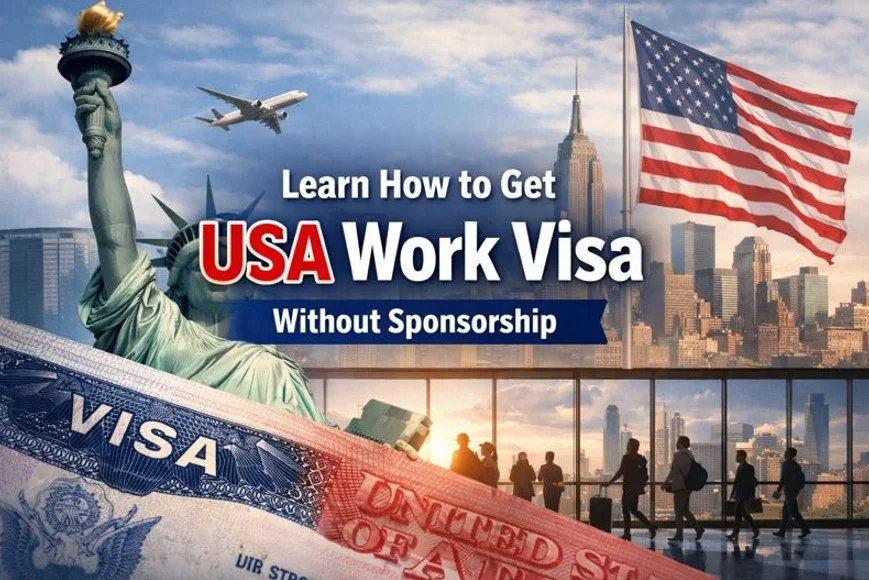
Learn How to Get USA Work Visa Without Sponsorship
How to get USA work visa without sponsorship is a question that more and more global professionals are asking in 2026 as the traditional employer-led immigration model becomes increasingly competitive and restrictive.
While many believe that a job offer from an American company is the only ticket into the U.S. labor market, several specialized pathways allow you to take the driver’s seat of your own career.
Whether you are a high-achieving researcher, a visionary entrepreneur, or a creative artist at the top of your game, the U.S. immigration system offers “self-petition” options that bypass the need for a corporate middleman.
How to get USA work visa without sponsorship involves understanding the nuances between temporary non-immigrant visas and permanent immigrant visas (Green Cards).
In 2026, the landscape has shifted toward “beneficiary-centric” models, where the U.S. government prioritizes individual talent and the potential national impact of your work over the administrative backing of a single employer.
By leveraging categories like the EB-1A for extraordinary ability or the EB-2 National Interest Waiver, you can secure your future in America without being tethered to a specific company’s payroll or the uncertainties of the H-1B lottery.
The Power of the Self-Petition: An Overview
The core of learning how to get USA work visa without sponsorship lies in the concept of the self-petition. Unlike traditional employment-based visas that function like a marriage between a company and an individual, a self-petition is a solo flight.
It is a legal mechanism that allows a foreign national to file their own immigration paperwork directly with the U.S. government, asserting that their individual merit is so significant that the country should grant them legal status regardless of who they work for.
In 2026, this pathway has become a cornerstone for global talent seeking to avoid the volatility of corporate hiring cycles and the rigid constraints of employer-bound visas.
Complete Autonomy Over Your Immigration Journey
When you master how to get USA work visa without sponsorship through self-petitioning, you transition from being a passive participant to the lead strategist of your own case.
In a sponsored scenario, the employer’s HR department and their chosen legal counsel decide when to file, how to describe your role, and what evidence to emphasize. If the company experiences a budget cut or a change in leadership, your visa process could be shelved or canceled entirely without your consent.
By self-petitioning, you hold the steering wheel. You choose the timing of your filing, you curate the narrative of your professional achievements, and you ensure that the application reflects your highest potential rather than just the requirements of a specific job description.
This independence is particularly vital for high-level researchers, innovators, and thought leaders whose work often spans multiple organizations or interdisciplinary fields.
Unprecedented Career Mobility and Flexibility
One of the most liberating aspects of discovering how to get USA work visa without sponsorship is the absolute freedom to move within the American labor market.
Traditional visas like the H-1B are “employer-specific,” meaning if you lose your job or decide to quit, you typically have only a 60-day grace period to find a new sponsor or leave the country. This creates a “golden handcuff” effect where talented professionals are afraid to leave toxic environments or pursue better offers.
A self-petitioned Green Card (like the EB-1A or EB-2 NIW), however, belongs to you. Once approved, you can work for a Fortune 500 company on Monday, consult for a startup on Wednesday, and launch your own LLC by Friday.
This flexibility allows you to follow the most lucrative and impactful opportunities as they arise, ensuring your career growth is never stunted by administrative red tape.
Strategic Control Over Professional Narratives
Self-petitioning empowers you to present a comprehensive picture of your impact that a single employer might overlook. When a company sponsors a visa, they focus on why you are the best fit for their specific vacancy.
In contrast, when you are learning how to get USA work visa without sponsorship, the focus shifts to how you benefit the entire United States.
This allows you to highlight your patents, your public speaking engagements, your contributions to open-source projects, and your influence on industry standards, achievements that may not be part of your daily “job duties” but are central to your value as a global expert.
You are not just a “Senior Engineer” or “Lead Researcher”; you are a “Critical Asset to American Innovation.” This higher-level framing often leads to stronger applications because it demonstrates a broader, more sustainable contribution to the national interest.
Bypassing the Onerous Labor Certification Process
A major hurdle in traditional sponsorship is the Program Electronic Review Management (PERM) labor certification. This process requires an employer to prove to the Department of Labor that there are no qualified, willing, or able U.S. workers to fill your position.
It is a grueling, months-long procedure involving mandatory job advertisements and strict recruitment audits that can easily fail if a single local applicant is deemed “minimally qualified.” By understanding how to get USA work visa without sponsorship, you essentially bypass this entire obstacle.
Self-petition categories like the National Interest Waiver (NIW) specifically waive the labor certification requirement.
This not only saves you (or an employer) from a bureaucratic headache but also shaves significant time off the total journey to permanent residency, allowing you to secure your status based on your own merits rather than the local unemployment rate in a specific city.
Speed and Precision via Premium Processing
In the fast-paced world of 2026, time is often as valuable as the visa itself. Many self-petitioning pathways are eligible for Premium Processing, a service where USCIS guarantees a response within a specific timeframe, typically 15 to 45 business days, for an additional fee.
While sponsored visas can also use this service, the decision to pay for it often rests with the employer’s budget.
When you take charge of how to get USA work visa without sponsorship, you decide when to trigger this “fast-track” option. For an EB-1A extraordinary ability petition, you can receive an approval in just over two weeks.
This rapid turnaround is a game-changer for professionals who need to finalize their status quickly to accept a high-stakes role, secure a mortgage, or provide stability for their families. It replaces years of “waiting and wondering” with a definitive, high-speed path to a decision.
The EB-1A Visa: For the “Extraordinary”
How to get USA work visa without sponsorship often leads ambitious professionals to the EB-1A “Extraordinary Ability” category. This is arguably the most prestigious and flexible path in the U.S. immigration system because it bypasses the need for an employer, a job offer, and the grueling labor certification process.
In 2026, the EB-1A remains the premier choice for individuals who can prove they are among the small percentage at the very top of their respective fields.
By self-petitioning, you are not just applying for a visa; you are presenting a case that your presence in the United States is a net gain for the nation’s excellence in science, art, education, business, or athletics.
The Standard of “Sustained National or International Acclaim”
To successfully navigate how to get USA work visa without sponsorship through the EB-1A, you must prove “sustained national or international acclaim.” This doesn’t mean you had one lucky break five years ago; it means your excellence is ongoing and recognized by your peers globally.
In 2026, USCIS looks for a trajectory of success, a consistent “paper trail” of achievement that shows you are currently at the peak of your career.
Whether it’s through a single, major internationally recognized award (like a Nobel Prize or an Oscar) or by meeting a combination of specific criteria, the goal is to show that your name is synonymous with high-level expertise in your niche.
Meeting the “3 Out of 10” Criteria Rule
If you haven’t won a Nobel Prize, the path to learning how to get USA work visa without sponsorship involves satisfying at least 3 of the 10 regulatory criteria.
These criteria are designed to be broad enough to cover various industries while remaining strict enough to ensure only the elite qualify. Common categories include:
- Judging the Work of Others: Being invited to review peer-reviewed journals, judge startup competitions, or sit on high-level award committees.
- Original Contributions of Major Significance: Proving that your research, patented technology, or business methods have been adopted industry-wide and have fundamentally changed the field.
- Leading or Critical Roles: Showing that you have held a “linchpin” position in a distinguished organization, one where the company’s success was directly tied to your individual performance.
The Importance of the “Final Merits Determination”
A common mistake for those researching how to get USA work visa without sponsorship is thinking that checking off three boxes is enough. In 2026, USCIS uses a two-step process called the “Kazarian” standard or the Final Merits Determination.
After an officer confirms you meet three criteria, they step back and look at the “totality of the evidence.” They ask: Does this person actually look like someone at the top of their field? This is where the narrative of your application becomes vital.
It’s not just about having the awards; it’s about explaining why those awards matter and how they prove you are an outlier in your profession.
Proving Your Intent to Continue Work in the U.S.
Even though you don’t need a job offer, you must prove that you intend to continue working in your area of expertise once you arrive. For those looking at how to get USA work visa without sponsorship, this is often handled through a “Statement of Intent” or “Professional Plan.”
In 2026, many applicants include non-binding letters of intent from potential collaborators, detailed business plans for their own consultancies, or evidence of ongoing research projects.
You must show the U.S. government that you aren’t just coming to retire on your past glory, but rather to continue contributing your “extraordinary ability” to the American landscape.
Accelerated Processing and Immediate Green Card Path
Perhaps the most significant benefit of the EB-1A when considering how to get USA work visa without sponsorship is its speed. It is a “First Preference” immigrant visa, which means for many countries, there is no waiting list (backlog) for a visa number.
Furthermore, the EB-1A is eligible for Premium Processing, where you pay a fee to receive an initial decision within 15 to 45 business days.
This turns what is usually a multi-year ordeal into a streamlined process that can see you holding a Green Card in less than a year. This speed is a massive advantage for high-performers who need to move quickly to seize global opportunities.
The EB-2 National Interest Waiver (NIW)
For many professionals, the most practical answer to how to get USA work visa without sponsorship is the EB-2 National Interest Waiver (NIW).
While the EB-1A “Extraordinary Ability” visa targets the very top 1% of a field, the EB-2 NIW is designed for a much broader group of highly skilled professionals whose work is of “national importance” to the United States.
In 2026, this category has seen a surge in popularity, particularly among STEM researchers, tech innovators, and entrepreneurs, because it allows you to skip the tedious employer-led labor certification (PERM) process entirely.
It is a “waiver” of the job offer requirement, meaning you can petition for your own Green Card based on the future impact of your work.
Bypassing the PERM Labor Certification
The primary hurdle of a standard EB-2 visa is the PERM process, which requires an employer to prove through rigorous advertising that no qualified U.S. workers are available for your role.
When you focus on how to get USA work visa without sponsorship through an NIW, you bypass this multi-year bureaucratic nightmare.
The U.S. government essentially agrees that your specific skills and proposed project are so valuable to the country that it would be “counterproductive” to make you go through a local labor market test.
This saves you nearly 18 to 24 months of processing time and gives you the freedom to change employers or launch your own company as soon as you arrive, provided you stay within the field of your “national interest” endeavor.
The Dhanasar Framework: Proving Your Value
To successfully obtain a USA work visa without sponsorship under this category, your application must satisfy the three “prongs” established by the landmark Matter of Dhanasar case. First, your proposed endeavor must have Substantial Merit and National Importance.
This doesn’t mean it has to be a nationwide project; even a localized endeavor in an economically depressed area or a niche scientific discovery can have national importance if the implications are broad.
Second, you must be Well-Positioned to Advance the Endeavor, meaning your education, track record, and current progress (such as patents, funding, or pilot programs) suggest you will actually succeed.
Finally, you must show that On Balance, it is Beneficial to the U.S. to waive the job offer requirement, essentially arguing that your individual contribution outweighs the government’s interest in protecting the local labor market for that specific role.
Priority for STEM and Critical Technologies
In 2026, the U.S. government has explicitly prioritized certain fields for the EB-2 NIW. If you are a professional in Artificial Intelligence, Cybersecurity, Renewable Energy, or Biotechnology, the path to learning how to get USA work visa without sponsorship is significantly smoother.
Recent policy updates have made it clear that holding an advanced degree (especially a Ph.D.) in these critical emerging technologies serves as a strong indicator of national importance.
USCIS officers are now trained to recognize that retaining global talent in these sectors is vital for American national security and economic competitiveness, leading to higher approval rates for technical specialists who can articulate how their work keeps the U.S. at the forefront of innovation.
The Entrepreneurial Advantage
The EB-2 NIW is also the secret weapon for startup founders. Traditionally, it was nearly impossible for a founder to sponsor themselves for a work visa because the “employer-employee relationship” was hard to prove when the founder owned the company.
However, when you pursue how to get USA work visa without sponsorship via the NIW, the lack of an employer is actually an advantage. You can present your business plan as your “proposed endeavor.”
If your startup has received venture capital, participated in a reputable accelerator, or holds proprietary intellectual property that solves a significant problem, you can argue that your role as a founder is of national importance.
This allows you to build your company on American soil without being tied to a corporate sponsor who might not share your long-term vision.
Flexibility and Long-term Career Stability
Choosing the EB-2 NIW is a strategic move for long-term stability. Because it is a “Second Preference” immigrant visa, it leads directly to a Green Card for you and your family. Unlike temporary work visas that require frequent renewals and “travel stamps,” the NIW provides a permanent solution.
Furthermore, because you are the petitioner, your status is not threatened if your company undergoes layoffs or if you decide to pivot your career.
As long as you continue to work in the general area of expertise described in your petition, your legal status remains secure. This peace of mind is why the NIW remains the gold standard for mid-to-senior level professionals globally.
The O-1 Visa: The “Artist & Genius” Shortcut
When exploring how to get USA work visa without sponsorship in the traditional sense, the O-1 visa often emerges as the most creative and agile solution.
While it is technically a non-immigrant (temporary) visa, it is colloquially known as the “Artist & Genius” visa because it is reserved for individuals who possess extraordinary ability in the sciences, arts, education, business, or athletics.
In 2026, the O-1 has become a favorite for high-growth startup founders and freelance creatives because it avoids the rigid “single-employer” trap that plagues other categories like the H-1B.
It offers a unique middle ground: you still need a petitioner, but that petitioner does not have to be your traditional “boss.”
The “Agent” Loophole
Technically, you cannot self-petition for an O-1. However, many savvy professionals use a U.S. Agent instead of a single employer. This allows you to work on multiple projects for different clients, essentially acting as a freelancer.
Why Choose O-1?
- Lower Bar than EB-1A: While still for “extraordinary ability,” the standard is slightly more flexible.
- No Cap: Unlike the H-1B, there is no annual limit on O-1 visas.
- Indefinite Extensions: You can renew the O-1 in one-to-three-year increments as long as you have work to do.
In the 2026 immigration landscape, the O-1 is frequently used as a “test run” for the EB-1A Green Card. Because the evidentiary requirements for both categories overlap significantly, getting an O-1 approved provides a massive boost of confidence and a pre-vetted portfolio of evidence for your future Green Card petition.
Many professionals use their time on an O-1 to gather even more “extraordinary” evidence, such as U.S.-based awards, press in American media, and high-salary contracts, ensuring that when they eventually file for their self-petitioned Green Card, their case is virtually bulletproof.
The Entrepreneur’s Path: Self-Sponsored H-1B and EB-5
the dream of launching a business on American soil has become more accessible than ever for global founders exploring how to get USA work visa without sponsorship from a third-party corporation.
While the traditional view of the H-1B is a visa for corporate “employees,” modern regulations have carved out a legitimate pathway for “beneficiary-owners”, entrepreneurs who own a controlling interest in their own companies.
Simultaneously, for those with significant capital, the EB-5 Immigrant Investor Program remains the most direct “buy-in” to the American Dream. Both paths allow you to bypass the need for a traditional boss, placing the power of sponsorship directly in your own hands.
The Self-Sponsored H-1B for Startup Founders
The most groundbreaking shift in learning how to get USA work visa without sponsorship is the formalization of the “Self-Sponsored H-1B.” Under the modernization rules in effect for 2026, you can indeed own 50% or even 100% of the U.S. company that petitions for your visa.
The critical requirement is proving a “bona fide” employer-employee relationship. This is typically achieved by establishing a corporate governance structure, such as a Board of Directors or independent managers, who have the legal authority to oversee your work, set your salary, and even terminate your employment if necessary.
This separation of control satisfies USCIS that the company is the employer, even if you are the visionary founder and majority shareholder.
Specialty Occupation Duties vs. Managing the Business
To succeed in a self-sponsored H-1B application, you must balance your dual roles as a business owner and a technical expert. USCIS requires that the position you hold within your startup qualifies as a “specialty occupation”, meaning it requires a specific bachelor’s degree or higher.
For instance, if you are a Software Engineer founding a FinTech startup, you must show that at least 51% of your daily duties involve high-level coding, systems architecture, or technical strategy.
The remaining time can be spent on “founder” tasks like fundraising, hiring, and operations. This ensures that the visa remains a tool for high-skilled professional work rather than just a way to manage a generic business.
The 18-Month Incremental Approval Strategy
A unique aspect of the entrepreneur’s H-1B is the specialized validity period. Unlike standard H-1B visas that are often granted for three years, a self-sponsored H-1B for a startup founder is initially approved for 18 months.
This “probationary” period allows the U.S. government to verify that your startup is a legitimate, revenue-generating enterprise and not a shell company.
After the first 18 months, you can apply for an extension for another 18 months, followed by the standard three-year extensions once the business has proven its viability through payroll records, client contracts, and tax filings.
The EB-5 Investor Visa: Direct Path to Permanent Residency
If you have access to capital, the EB-5 visa is the ultimate answer to how to get USA work visa without sponsorship.
In 2026, the minimum investment amounts are standardized at $800,000 for Targeted Employment Areas (TEAs), which include rural or high-unemployment regions, and $1,050,000 for non-TEA projects.
The beauty of the EB-5 is its simplicity of purpose: you invest the money, and in return, you (along with your spouse and children) receive a Green Card. This path is entirely self-directed; you are the investor, and your “sponsorship” is your capital’s contribution to the American economy.
The 10-Job Creation Mandate
The “work” requirement of the EB-5 is not about your personal labor, but the labor you create for others. Every EB-5 investment must result in the creation or preservation of at least 10 full-time jobs for qualifying U.S. workers within a two-year period.
You can choose a “Direct Investment,” where you start your own business and hire the employees yourself, or you can invest through a “Regional Center.”
Regional Centers are USCIS-approved entities that pool investor funds for large-scale projects (like hotels or tech parks) and use economic models to count “indirect” and “induced” jobs.
For many, the Regional Center route is the preferred way to get a USA work visa without sponsorship because it shifts the burden of job creation and day-to-day management onto professional developers.
Lawful Source of Funds: The Ultimate Audit
Regardless of whether you choose the H-1B or the EB-5 path, the U.S. government will perform an exhaustive audit of your finances.
For the EB-5, you must prove a “Lawful Source of Funds”, tracing every dollar of your investment back to its origin, whether it’s from salary, business profits, the sale of property, or a legal gift.
In 2026, USCIS has even established clear guidelines for converting cryptocurrency and other digital assets into qualifying investment capital. This transparency is the bedrock of the program, ensuring that self-sponsored entrepreneurs are building the American economy with legitimate, documented wealth.
Conclusion
Navigating the complexities of how to get USA work visa without sponsorship requires a shift in mindset. You are no longer looking for a “boss” to grant you permission; you are presenting yourself as an asset that the United States cannot afford to miss. In 2026, the doors are open for those who can prove their worth through documentation, dedication, and a clear vision of their contribution to the American economy.