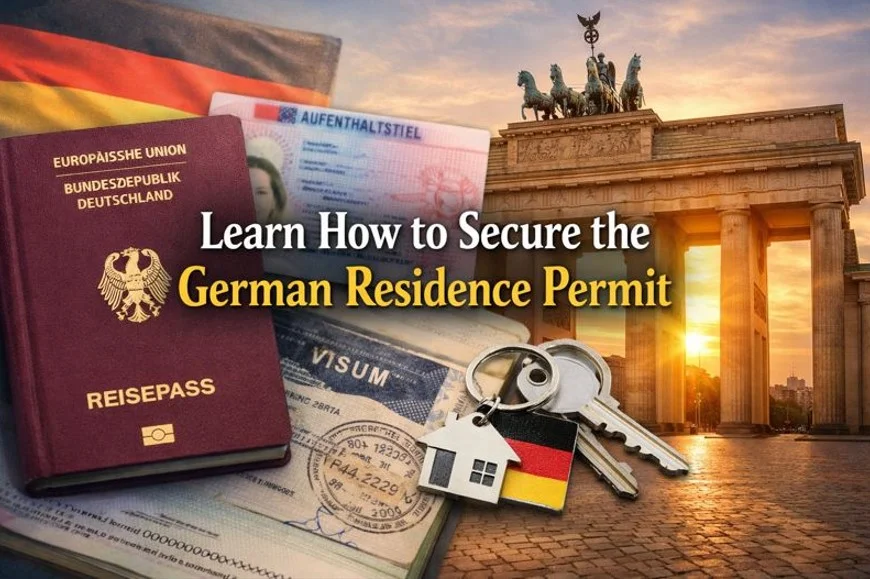
Learn How to Secure the German Residence Permit
Securing a German residence permit is the definitive first step for anyone looking to build a long-term future in Europe’s largest economy.
Whether you are a skilled professional, a dedicated student, or someone moving to join family, understanding the nuances of the German residence permit is essential for a smooth transition.
In 2026, Germany has continued to modernize its immigration pathways, making the “Land of Ideas” more accessible than ever, provided you know exactly how to navigate the bureaucratic landscape.
The German residence permit, known locally as an Aufenthaltstitel, is more than just a document; it is your legal gateway to living, working, and thriving in a society known for its stability and innovation.
While the process might seem daunting at first glance, filled with terms like Ausländerbehörde and Anmeldung, securing your German residence permit is entirely manageable when broken down into actionable steps.
This guide will walk you through the types of permits available, the latest 2026 requirements, and the secret tips to ensure your application is successful on the first try.
Understanding the Different Types of German Residence Permits
Securing a German residence permit requires a clear understanding of the specific category that fits your life goals.
Each permit is designed with a unique set of criteria, rights, and long-term prospects. Below is an expanded breakdown of the primary pathways available in 2026.
The Temporary Residence Permit (Aufenthaltserlaubnis)
The Temporary Residence Permit is the most versatile and common form of the German residence permit, acting as an initial “probationary” period for most newcomers.
Issued for purposes such as employment, study, or family reunification, this permit is strictly purpose-bound, meaning if you move for a specific job and lose that job, you must notify the authorities to update your status.
In 2026, the German government has increased the flexibility of this permit, allowing holders to switch between different types of employment more easily than in previous years.
Typically issued for one to three years, it is the essential foundation upon which you build your years of residency to eventually qualify for permanent status.
The EU Blue Card for Highly Qualified Professionals
For those with a university degree and a high-paying job offer, the EU Blue Card is the gold standard of the German residence permit.
As of January 2026, the salary thresholds have been adjusted to reflect current economic conditions, requiring a gross annual income of €50,700 for standard professions and €45,934.20 for shortage occupations like IT, medicine, and engineering.
The Blue Card is not just a work permit; it is an accelerated track to permanent residency. If you possess B1-level German language skills, you can apply for a settlement permit after just 21 months of residence, making it the fastest way to secure your long-term future in the country.
The Opportunity Card (Chancenkarte)
The Opportunity Card is a revolutionary addition to the German residence permit family, designed for skilled workers who do not yet have a concrete job offer. This points-based permit allows you to live in Germany for up to one year to search for a qualified position.
To secure this version of the German residence permit, you must earn at least six points based on criteria such as your age, language proficiency (German A1 or English B2), and previous professional experience.
While on this permit, you are legally allowed to work up to 20 hours per week in “trial” jobs, providing a financial safety net while you hunt for a permanent career role.
The Residence Permit for Students and Vocational Learners
Germany remains a top destination for global talent, and the student German residence permit is the primary vehicle for academic seekers. This permit is granted to those who have been accepted into a recognized German university or vocational training program.
In 2026, students benefit from expanded working rights, allowing them to work up to 140 full days (or 280 half days) per year to support their studies.
Upon graduation, this permit can be extended for up to 18 months, specifically for the purpose of finding a job that matches your degree, effectively transitioning you into a professional work permit.
The Residence Permit for Researchers and Scientists
Specialized academic and scientific personnel can apply for a dedicated German residence permit tailored to the needs of the research community. This permit is often issued to those who have a “hosting agreement” with a German research institute or university.
Unlike standard work permits, the researcher permit allows for greater mobility within the EU, permitting you to conduct parts of your research in other member states without needing additional visas.
It also simplifies the process for family members to join you, ensuring that the best minds in the world can focus on their work with their loved ones by their side.
The Settlement Permit (Niederlassungserlaubnis)
The Settlement Permit is the ultimate version of the German residence permit, granting you the right to live and work in Germany indefinitely. This is no longer a temporary “stay”; it is permanent residency.
Generally, you can qualify for this after five years of legal residence, provided you have paid into the German pension system for at least 60 months and can demonstrate B1 German proficiency.
However, 2026 regulations have maintained “fast-track” options for skilled workers, who can often settle permanently after only three years if they are well-integrated and financially independent.
Essential Requirements for a Successful Application
While each category of the German residence permit has its own nuances, a set of core “universal requirements” remains the bedrock of every application in 2026.
The German Ausländerbehörde functions on a culture of meticulous documentation; missing even a single item can lead to delays or the immediate rejection of your German residence permit request.
A Valid Passport with Long-Term Longevity
The most fundamental requirement for any German residence permit is a valid national passport. In 2026, officials strictly enforce the “six-month rule,” meaning your passport must be valid for at least six months beyond the intended expiration date of your new permit.
Furthermore, your passport must have at least two blank pages to accommodate the physical adhesive labels or entry stamps, even if you are ultimately issued an electronic residence card (eAT).
If your passport is nearing its expiration date, it is highly recommended to renew it at your national embassy before attending your German residence permit appointment.
Proof of Purpose: The “Why” Behind Your Move
You cannot secure a German residence permit simply by wanting to live in Germany; you must have a legally recognized reason. For workers, this is a signed employment contract that clearly states your salary, job title, and the number of hours you will work weekly.
For students, it is a formal Zulassungsbescheid (letter of admission) from a state-recognized German university.
For those moving for family reasons, a legalized marriage or birth certificate, often with an Apostille and a certified German translation, is the essential “Proof of Purpose” required for your German residence permit dossier.
Comprehensive German Health Insurance
In 2026, German law remains unyielding: every resident must be insured by a provider recognized by the German Federal Financial Supervisory Authority (BaFin).
When applying for a German residence permit, standard travel insurance or international plans from your home country are typically rejected because they do not meet the minimum statutory coverage requirements (SGB V).
If you are employed, you will likely be enrolled in “Public” insurance (Gesetzliche Krankenkasse), where your employer pays half.
If you are a freelancer or a high-earner (earning over €77,400 annually in 2026), you may opt for “Private” insurance, but you must ensure the policy is “residency-compliant” to satisfy the requirements of your German residence permit.
Financial Stability and the “Secure Livelihood”
To obtain a German residence permit, you must prove that you can support yourself (and any dependents) without relying on German social welfare. For employees, three months of recent payslips or a “Salary Statement” from your employer is sufficient.
For students and job seekers, the Blocked Account (Sperrkonto) is the standard. As of 2026, the required amount is approximately €11,904 per year (€992 per month).
This money is deposited into a German bank and “blocked,” with the bank releasing only the monthly allowance to your current account, proving to the authorities that your German residence permit is backed by liquid assets.
Adequate Housing and the “Anmeldung” Certificate
Germany requires every resident to live in “adequate” living space, which generally means at least 12 square meters per person (for those over 6 years old).
When you apply for your German residence permit, you must provide a signed rental agreement (Mietvertrag) and the Wohnungsgeberbestätigung, a specific form signed by your landlord confirming you have moved in.
This document allows you to complete your Anmeldung (address registration), and the resulting Meldebescheinigung is a mandatory document for your German residence permit file, as it proves your local jurisdiction.
Biometric Photographs and Technical Specifications
Even the smallest detail, like your photo, can stall a German residence permit application. You must provide two identical, recent (taken within the last six months) biometric photos.
These must be 35mm x 45mm, with a neutral facial expression, a closed mouth, and a plain, light-grey background.
Your face must occupy 70–80% of the photo. In 2026, many immigration offices have digital kiosks where you can take these photos and have them transmitted directly to the officer’s computer, but it is always safer to bring physical copies to your German residence permit interview just in case.
Step-by-Step Strategies for Securing the Germany Residence Permit
Securing a residence permit (Aufenthaltstitel) in Germany is a bureaucratic marathon, not a sprint. With the significant updates to the Skilled Immigration Act (2024–2026) and the introduction of the Opportunity Card (Chancenkarte), the process has become more accessible but requires precise adherence to new regulations.
Below are the comprehensive, step-by-step strategies to navigate this process successfully.
1. Determine Your Specific Permit Category
Before any paperwork begins, you must identify which “paragraf” of the German Residence Act you fall under. Germany does not have a “one-size-fits-all” permit.
Common categories include Section 18b for skilled workers with a degree, Section 19c for those with practical professional experience (newly expanded in 2026), or the EU Blue Card, which is the gold standard for high-earning academics.
Each category has its own salary threshold; for example, as of 2026, the standard Blue Card threshold is approximately €50,700, though it is lower for “shortage occupations” like IT or healthcare.
Selecting the wrong category can lead to an immediate rejection or long delays, as the requirements for “qualified employment” are strictly checked by the Federal Employment Agency (BA).
2. Secure the Correct National Visa (D-Visa)
If you are from a non-EU country (excluding “Best Friends” nations like the USA, Canada, or Australia), you cannot simply arrive as a tourist and apply for a residence permit. You must apply for a National (D) Visa at the German embassy in your home country.
This visa is the prerequisite for the long-term residence permit. The strategy here is to apply for the visa that exactly matches your ultimate residence purpose, if you enter on a “Job Seeker” visa but have a signed contract, you must ensure the embassy issues the correct entry clearance.
Entering on a Schengen (C) visa to apply for a long-term permit is a common mistake that often results in the authorities asking you to leave Germany and start over from your home country.
3. The “Anmeldung” (Address Registration)
The moment you arrive in Germany, your first legal obligation is the Anmeldung. You must register your address at the local Bürgeramt (Citizens’ Office), usually within 14 days of moving into your accommodation.
You will need a signed “Wohnungsgeberbestätigung” (Landlord’s Confirmation) to complete this. This step is non-negotiable because you cannot receive a tax ID, open a bank account, or book a residence permit appointment without the Meldebescheinigung (Registration Certificate).
In major cities like Berlin or Munich, appointments are notoriously scarce, so the best strategy is to refresh the booking portal at 7:00 AM daily or look for appointments in smaller surrounding districts.
4. Obtain German-Compliant Health Insurance
Standard travel insurance or “global” plans from your home country are rarely accepted by the Foreigners’ Office (Ausländerbehörde). To secure a residence permit, you must prove you have health insurance that meets the specific German “substitute” requirements (SGB V).
If you are an employee, you will typically be enrolled in the Public Health Insurance system (AOK, TK, etc.). If you are a freelancer or student over 30, you may need a specialized private plan.
Ensure your provider issues a “Mitgliedsbescheinigung” specifically for the immigration office, as a simple insurance card is often insufficient for the application.
5. Prepare the “Financial Livelihood” Evidence
Germany’s primary concern is that you will not become a burden on the state. For students and job seekers, this usually means a Blocked Account (Sperrkonto) containing at least €11,904 (for 2025/2026 figures).
For employees, this means your employment contract must show a salary that covers your cost of living and matches the current legal thresholds. If you are self-employed, you must provide a detailed business plan and often a formal evaluation from the Chamber of Commerce (IHK) or a tax consultant’s report.
The strategy here is “over-documentation”, provide the last three months of bank statements and salary slips even if only one is requested.
6. Secure an Appointment at the Ausländerbehörde
This is often the most difficult step due to administrative backlogs. Most offices now use online booking systems. You should aim to book your appointment at least 8 weeks before your entry visa expires.
If you cannot find an appointment, the legal strategy is to send a formal “Antrag” (application) via registered mail or their online portal.
This triggers a Fiktionsbescheinigung (Fictional Certificate), which legally extends your current stay and work rights until the office can process your case, even if your original visa expires in the meantime.
7. The Personal Interview and Biometrics
On the day of your appointment, you must bring original documents and two sets of copies. The interview is generally straightforward but requires a “professional meeting” mindset. You will be asked about your role, your company, or your studies.
If your German is not yet at a functional level, it is highly recommended to bring a translator or a German-speaking friend, as many case officers are legally required to conduct the interview in German to ensure there are no misunderstandings.
During this session, they will also take your fingerprints and a biometric photo for your eAT (electronic residence permit) card.
8. Wait for Processing and Collection
Once submitted, the Federal Employment Agency may be consulted behind the scenes to verify your labor market priority.
This usually takes 4 to 12 weeks. Once approved, you will receive a “PIN-Brief” in the mail, which contains the codes for your card’s online functions. You will then return to the office to collect your physical card.
Pro Tip: Keep your Fiktionsbescheinigung and your original passport together at all times during this waiting period, as this combination is your only proof of legal residency while your card is being printed in Berlin.
Recent Updates for Considerations in 2026
The landscape for the German residence permit has undergone a significant transformation as of January 2026.
These updates are designed to balance Germany’s desperate need for 400,000 skilled workers annually with a renewed focus on sustainable integration. Staying informed on these 2026 shifts is the difference between a seamless move and a bureaucratic stalemate.
The Global Rollout of the Consular Services Portal
As of early 2025 and fully realized in 2026, the German residence permit application process has moved into the digital age. The “Consular Services Portal” is now operational across all 167 German visa sections worldwide.
This “administrative revolution” allows you to apply for 28 different categories of national visas and residence permits online. By uploading your documents digitally for a “pre-check” before your in-person appointment, you can reduce processing times from several months to as little as 4–6 weeks.
This digital-first approach minimizes the risk of missing documents and ensures that when you finally walk into the embassy, your German residence permit is already halfway to approval.
New Salary Thresholds for the EU Blue Card
Economic adjustments in 2026 have led to a rise in the minimum income requirements for the EU Blue Card, a popular tier of the German residence permit.
To qualify, standard professionals must now earn a gross annual salary of €50,700. However, to combat labor shortages, the threshold for “shortage occupations”, which now includes nursing, teaching, and green-tech engineers alongside IT and medicine, has been set at €45,934.20.
It is critical to ensure your employment contract reflects these 2026 figures; the authorities will reject applications based on outdated 2025 salary scales, even if the contract was signed late last year.
The “Work-and-Stay” Agency and Digital Integration
2026 marks the launch of the federal “Work-and-Stay” Agency, a centralized body designed to streamline the coordination between local immigration offices (Ausländerbehörden) and the Federal Employment Agency. For many applicants, this means a “one-stop-shop” experience for their German residence permit.
Additionally, under the Online Access Act (OZG), major cities like Berlin, Munich, and Hamburg now offer fully digital workflows for permit extensions.
This means that once you have your initial German residence permit, renewing it often requires only a few clicks and an uploaded scan of your current contract, rather than a physical trip to the office.
Expanded Family Reunification Rights
In a progressive move for 2026, Germany has simplified the process for family members to join holders of a skilled worker German residence permit.
One of the most significant updates is the removal of the “sufficient living space” requirement for spouses and minor children of EU Blue Card holders and certain skilled professionals.
Furthermore, if you are a Blue Card holder who arrived after March 2024, you can now apply for a German residence permit for your parents and even your parents-in-law, provided their livelihood is secured. This makes Germany one of the most family-friendly destinations for high-tier global talent.
Mandatory Employer Information Obligations
Effective January 1, 2026, a new legal obligation has been placed on German employers to protect the rights of those holding a German residence permit.
Employers must now inform any third-country national they hire, no later than their first day of work, about their right to seek advice from labor and social law counseling centers.
This update ensures that holders of a German residence permit are not only seen as labor resources but as protected members of the workforce with full access to legal support and integration resources from the moment they start their new journey.
Tightened Naturalization and Integration Rules
While the 2024 reforms initially shortened the path to citizenship, 2026 has seen a slight recalibration.
The regular residency requirement for naturalization remains at five years, but the controversial “three-year fast-track” for citizenship has been restricted to cases of truly exceptional integration achievements.
For most people holding a German residence permit, the focus in 2026 is on “sustainable integration.” This means that while you can live and work indefinitely with a settlement permit, the transition to a German passport now explicitly requires a proven long-term linguistic and economic commitment to the country.
Conclusion
Securing a German Residence Permit is more than just a legal requirement; it is a commitment to your new life in one of the world’s most stable and vibrant economies. While the paperwork might feel like a hurdle, it is a transparent system that rewards those who are prepared and diligent. By understanding the specific criteria for your German Residence Permit and following the steps outlined above, you can turn your German dream into a reality.