Finding the Best Ultrawide Monitor for Sim Racing
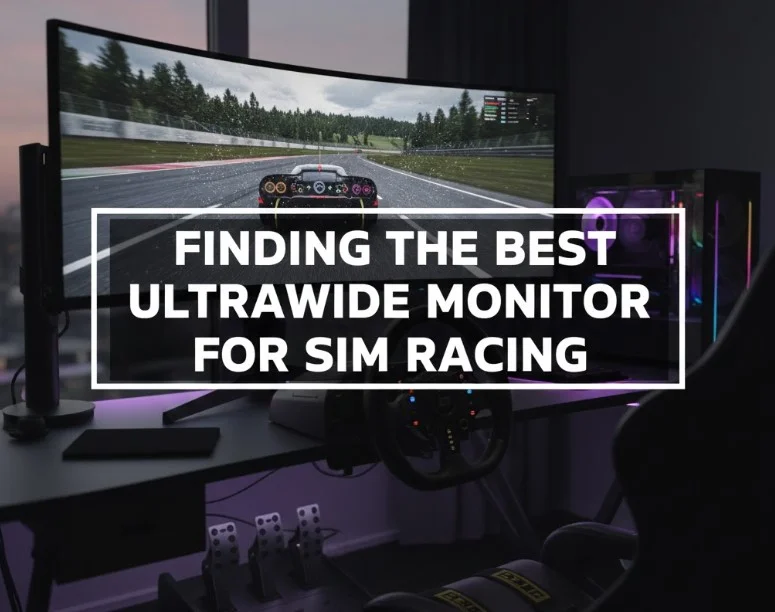
The pursuit of the perfect digital racetrack experience is a journey every dedicated enthusiast understands, and finding the best ultrawide monitor for sim racing is now the ultimate goal for those seeking maximum immersion from a single screen.
When it comes to visual fidelity, a panoramic display fundamentally transforms a sim rig, offering a breathtaking field-of-view (FOV) that strikes a glorious compromise between the simplicity of a standard 16:9 display and the visual complexity of a triple-screen setup.
Forget the hassle of bezels, complex alignment, and extreme GPU demands; the modern ultrawide, particularly in the 32:9 Super Ultrawide format, delivers a seamless, continuous image that allows you to use your peripheral vision to spot rivals and hit apexes with newfound confidence.
Choosing the best ultrawide monitor for sim racing involves prioritizing critical specifications that directly impact competitive performance and feel.
It’s not just about screen size; it’s about speed and clarity, which means focusing on a high refresh rate (144Hz and above), ultra-low response time (preferably 1ms GtG or an OLED’s near-instant response), and a resolution that your graphics card can handle comfortably, typically 3440×1440 or 5120×1440.
This guide will delve into the critical technical factors, from the benefits of an aggressive 1000R curve to the sheer speed of OLED technology, ensuring you select the single piece of hardware that will truly elevate your virtual driving experience to championship levels.
Qualities and Features that Makes the Best Ultrawide Monitor for Sim Racing Setup
The single most defining feature that makes a display the best ultrawide monitor for sim racing is its ability to deliver an expansive and crucial Field of View (FOV) without the visual distractions of bezels.
This begins with the aspect ratio, where the massive 32:9 Super Ultrawide format truly shines. A 49-inch monitor with a 32:9 ratio is essentially the horizontal equivalent of two 27-inch 16:9 monitors placed seamlessly side-by-side, providing a near-perfect single-screen approximation of a triple-monitor setup.
This immense width wraps the track around the driver, enabling the use of proper, realistic FOV settings that dramatically improve depth perception and spatial awareness.
This FOV allows you to naturally monitor your side mirrors and see rivals tucked into your blind spots; a vital competitive advantage that is simply not possible with a standard 16:9 screen, regardless of its size.
High Refresh Rate and Ultra-Low Response Time
In the competitive world of sim racing, where milliseconds separate a podium finish from a crash, the display’s speed is paramount, making high refresh rate and response time essential qualities of the best ultrawide monitor for sim racing.
The refresh rate, measured in Hertz (Hz), dictates how many times per second the monitor updates the image. A minimum of 120Hz is required for a smooth, stable image, but the true competitive sweet spot lies in the 144Hz to 240Hz range.
This high frequency drastically reduces perceived input latency and minimizes the time lag between your steering wheel input and the car’s visual reaction on screen.
Coupled with this is the response time, which must be 1ms Grey-to-Grey (GtG) or, ideally, the near-instantaneous $0.03\text{ms}$ offered by modern OLED panels.
A rapid response time eliminates motion blur and ghosting, ensuring that when the environment is flying past at high speed, the track edges, braking markers, and opponent cars remain razor-sharp, allowing for precise visual judgment in critical moments.
Aggressive Curvature
While all ultrawides are curved, the curvature radius is a critical factor distinguishing a good ultrawide from the best ultrawide monitor for sim racing experience. The curve radius is measured in ‘R’, and a lower number indicates a more aggressive, deeper curve.
For sim racing, a radius of 1000R is considered the gold standard. This aggressive curve is specifically engineered to match the natural curvature of the human eye, ensuring that every point on the vast screen is an equidistant focus point from the driver’s perspective.
On a large 49-inch panel, this deep curve pulls the edges of the display into the user’s peripheral view, creating an enveloping “cockpit” effect.
This physical wrap-around is what unlocks the monitor’s potential to convincingly simulate the feel of a real race car windshield, reducing eye strain over long endurance stints and enhancing the critical sense of speed and depth needed to hit braking points with consistency.
Panel Technology: The Contrast and Color Advantage (OLED/QD-OLED)
The panel technology fundamentally dictates the visual quality, which, for the best ultrawide monitor for sim racing, translates directly into superior immersion and detail visibility.
While IPS (In-Plane Switching) and VA (Vertical Alignment) panels are popular, OLED (Organic Light-Emitting Diode) and its Quantum Dot variant, QD-OLED, now reign supreme for racing simulators.
These technologies feature self-emissive pixels, meaning each pixel can be individually turned completely off, resulting in perfect blacks and infinite contrast.
This is an immense advantage in sim racing, particularly during night races or when driving through tunnels, as it reveals unparalleled detail in shadows; details that could hide a crucial apex marker or a damp patch of track.
Furthermore, OLED panels offer exceptional color vibrancy and, as noted previously, the fastest possible response times, ensuring that the breathtaking contrast and color are delivered with zero motion artifacts.
High Native Resolution: The Pixel Density for Clarity
For a single-screen setup to truly replace the immersion of a triple-screen rig, the best ultrawide monitor for sim racing must possess a high native resolution to maintain image clarity across its expansive surface.
The standard ultrawide resolution is 3440×1440 (UWQHD), which offers a great balance of clarity and GPU performance.
However, for the large 49-inch Super Ultrawide format, the preferred resolution is 5120×1440 (DQHD), which provides the necessary pixel density to maintain a sharp, detailed image even when sitting close to the screen in a dedicated rig.
A high resolution ensures that small details, such as distant trackside advertisements, tiny cracks in the asphalt, and subtle changes in weather effects, are rendered with precision.
While this resolution requires a powerful graphics card to maintain the desired high frame rates, the resulting crystal-clear visual experience significantly contributes to better focus and reduced distraction during intense racing sessions.
Adaptive Synchronization Technology: Eliminating Screen Tearing
A high frame rate is useless if the image on the screen is marred by visual inconsistencies; therefore, built-in adaptive sync technology is an essential requirement for the best ultrawide monitor for sim racing.
Adaptive sync technologies, such as NVIDIA G-Sync and AMD FreeSync Premium/Pro, work by dynamically matching the monitor’s refresh rate to the exact frame rate output of the graphics card.
This synchronization process entirely eliminates the irritating visual anomaly known as screen tearing, where parts of two different frames appear simultaneously. It also prevents stuttering caused by frame rate dips.
In sim racing, where the camera’s movement is constant and rapid, tearing is highly distracting and can momentarily break concentration. By ensuring a consistently smooth, artifact-free image, adaptive sync allows the driver’s focus to remain entirely on the critical task of hitting their marks and managing their car’s balance.
The Critical Specs: What Makes the Best Ultrawide Monitor for Sim Racing Perform?
Choosing your next ultrawide isn’t just about size; it’s about speed, clarity, and responsiveness. In sim racing, a fraction of a second can mean the difference between victory and a gravel trap.
To qualify as the best ultrawide monitor for sim racing, a display must excel across these technical criteria.
Native Resolution: Pixel Count for Immersion and Detail
The resolution of the best ultrawide monitor for sim racing directly impacts the sharpness and visual detail of the virtual environment, which is crucial for immersion and judging distance. The most common and effective ultrawide resolutions are 3440×1440 (UWQHD) for 34-inch models and 5120×1440 (DQHD) for 49-inch models.
The UWQHD resolution is often considered the sweet spot for many mid-to-high-end systems, offering a significant detail upgrade over 1080p without excessively burdening the GPU, allowing easier maintenance of high frame rates.
However, the DQHD resolution, which is essentially two 1440p monitors merged, provides the ultimate clarity on a single super ultrawide panel.
This massive pixel canvas ensures fine trackside details, distant braking markers, and cockpit instruments remain crisp, delivering an undeniable sense of realism, though it mandates a top-tier graphics card (like a contemporary ’90’ series GPU) to drive the over 7.3million pixels necessary for competitive speed.
High Refresh Rate: Smoothness Equals Competitive Speed
The refresh rate, measured in Hertz (Hz), is arguably the most vital performance specification for the best ultrawide monitor for sim racing, as it dictates the fluidity of the on-screen motion and, crucially, the system’s input latency.
While the minimum acceptable standard for sim racing starts around 100 Hz, the competitive baseline is firmly established at 144Hz to 165Hz. T
his range provides a buttery-smooth visual experience, making it easier to track rapidly moving objects like the curb apex or a competitor’s car during a wheel-to-wheel battle.
However, for those seeking the ultimate competitive edge and lowest possible latency, premium monitors push to 240Hz or higher.
This ultra-high refresh rate minimizes motion blur and ensures the monitor can instantaneously display the latest frame rendered by the GPU, translating into the most responsive and reactive driving experience possible; provided your PC hardware is powerful enough to consistently generate frames at that demanding rate.
Response Time and Panel Technology: Eliminating Visual Lag
The response time, quantified in milliseconds (ms), determines how quickly a pixel can switch from one state to another, and its effectiveness is heavily influenced by the monitor’s underlying panel technology, making it a critical factor for the best ultrawide monitor for sim racing.
Slow response times manifest as ghosting or motion blur, where trailing artifacts obscure details behind fast-moving objects, which is extremely distracting when attempting to judge speed and distance on the track.
Therefore, a target of 1ms Grey-to-Grey (GtG) is a standard requirement for LCD-based panels (IPS/VA). However, the absolute highest tier is now dominated by OLED and QD-OLED technology. These panels offer a near-instantaneous pixel response time, often cited at 0.03ms, effectively eliminating all motion blur and ghosting.
This instantaneous speed, combined with OLED’s perfect blacks and infinite contrast, delivers unparalleled clarity and visual fidelity, making it the superior choice for drivers who refuse to compromise on either image quality or speed.
Adaptive Synchronization: Maintaining Consistent Visuals
An essential feature for any high-performance display to qualify as the best ultrawide monitor for sim racing is the implementation of Adaptive Sync technology, which is paramount for maintaining a smooth, tear-free image.
This technology, which includes NVIDIA G-Sync and AMD FreeSync Premium/Pro, synchronizes the monitor’s refresh rate with the graphics card’s fluctuating frame rate output. In graphically demanding sim titles, frame rates inevitably fluctuate as the car moves across the track or when multiple cars converge in a pack.
Without adaptive sync, this frame rate variance results in disruptive screen tearing and stuttering. By dynamically adjusting the refresh rate, the monitor ensures that only complete frames are displayed, eliminating these visual artifacts.
This guarantees a consistently smooth and cohesive image that allows the racer to maintain peak concentration and accuracy, especially during high-stakes maneuvers where visual stability is non-negotiable.
Curve and Size: The Geometry of Immersion
When you venture into the ultrawide monitor space, particularly with the vast 32:9 Super Ultrawide format, the physical geometry of the display becomes a primary determinant of immersion.
These factors are meticulously engineered to replicate the field of view and sight lines of a real-world cockpit, making them essential features of the best ultrawide monitor for sim racing.
The Aggressive Curve (1000R to 1500R)
The curvature of an ultrawide monitor is defined by its radius, measured in ‘R’. A smaller ‘R’ value signifies a deeper, more aggressive curve. For the ultimate sim racing experience, an aggressive curve of 1000R is highly sought after.
This specific radius is designed to closely match the natural curvature of the human eye, ensuring that every point on the expansive screen is equidistant from the driver’s perspective. On a large panel, this geometry eliminates the unnatural flattening and distortion that would occur at the edges of a flat ultrawide screen.
By wrapping the display around the driver, the 1000R curve effectively pulls the horizontal edges into the peripheral vision. This provides a crucial visual cue, the ability to glance sideways and perceive objects outside the main forward view, significantly enhancing the sense of speed, spatial awareness, and cockpit realism.
More moderate curves, such as 1500R or 1800R, are still a huge improvement over a flat screen but offer less of the total immersion desired by dedicated sim racers.
Size Factor: 34-inch vs. 49-inch (21:9 vs. 32:9)
The physical size and corresponding aspect ratio are critical choices that determine the monitor’s impact on your sim racing setup. The 34-inch (21:9) ultrawide is an excellent entry point, offering a substantial boost in horizontal field of view over a traditional 16:9 monitor and being less demanding on a gaming PC.
It provides a highly cinematic and immersive experience without requiring a dedicated, deep mounting solution. However, the champion for the best ultrawide monitor for sim racing is the 49-inch (32:9) Super Ultrawide format.
This massive panel provides the width necessary to truly simulate a triple-screen setup’s peripheral vision with a single, seamless image.
The extra width is what enables the user to achieve a correct, wider Field of View (FOV) setting in-game without the perspective distortion that plagues smaller screens, granting the crucial ability to see competitors alongside you without shifting your head. This immense size, especially when paired with an aggressive curve, turns a desk setup into a virtual cockpit.
Top Contenders: The Best Ultrawide Monitor for Sim Racing Models
The sim racing monitor market is fiercely competitive, with manufacturers constantly pushing the boundaries of size, speed, and panel technology.
The current top contenders for the best ultrawide monitor for sim racing models are primarily defined by the adoption of OLED technology, which delivers the near-instantaneous response times and perfect contrast essential for high-fidelity digital racing.
Samsung Odyssey OLED G9 (G95SC/G93SC): The Super Ultrawide King
The Samsung Odyssey OLED G9 stands as the pinnacle of single-screen immersion for dedicated sim racers. This 49-inch, 32:9 super ultrawide beast features a 5120×1440 DQHD resolution and an incredibly fast 240Hz refresh rate.
More importantly, it leverages a QD-OLED panel, which provides the perfect blacks and infinite contrast ratio that makes night races breathtakingly realistic, combined with a near-instant 0.03ms response time for zero motion blur.
While its curvature is a more gentle 1800R (compared to some of Samsung’s older 1000R models), the sheer size makes up for this by filling the driver’s peripheral vision, delivering an experience that comes closest to a triple-screen setup without the complication of bezels or alignment.
This is the monitor for the enthusiast who prioritizes maximum field of view and elite-tier performance on a single display.
Dell Alienware AW3423DWF: The QD-OLED Performance Sweet Spot
The Dell Alienware AW3423DWF is often regarded as the benchmark for a balanced, high-performance ultrawide, offering the exceptional benefits of QD-OLED technology in the more traditional and easier-to-drive 34-inch, 21:9 format.
Its 3440×1440 resolution is less demanding on the GPU than its 49-inch rivals, allowing mid-to-high-end graphics cards to comfortably maintain its 165Hz refresh rate for a buttery-smooth experience.
While its 1800R curve is relatively subtle, the monitor’s strength lies in its 0.1ms (GtG) response time (effectively instantaneous) and superior color volume, which brings the vibrant liveries and detailed tracks of sim racing to life.
For racers looking for an elite-tier visual experience without the space requirements or extreme cost of a super ultrawide, this monitor represents the perfect fusion of panel speed and immersive aspect ratio.
Samsung Odyssey Neo G9 (Mini-LED): The Brightness and Clarity Champion
For those who are wary of the potential for OLED burn-in or who simply demand maximum brightness for daytime gaming sessions, the Samsung Odyssey Neo G9 offers a compelling Mini-LED alternative.
This 49-inch, 32:9 monitor matches the OLED G9’s 5120×1440 DQHD resolution and 240Hz refresh rate, but its key differentiator is the Mini-LED backlight, which boasts thousands of local dimming zones.
This technology allows it to achieve extreme peak brightness levels (often DisplayHDR 1000 certified), making HDR content pop with incredible brilliance and delivering a stark, impactful image quality that rivals OLED in some scenarios, albeit with the potential for minor blooming artifacts.
Older generations of the Neo G9 feature the extremely aggressive 1000R curvature, providing the ultimate wrap-around effect that many sim racers find completely indispensable for immersion.
LG UltraGear 45GR95QE: The Aggressive Curve Alternative
The LG UltraGear 45GR95QE carved out its own niche by introducing an aggressive 800R curvature to a 45-inch, 21:9 format, a geometry that is nearly unmatched in terms of screen wrap-around.
This depth of curve significantly enhances the feeling of being enclosed within a cockpit, maximizing peripheral engagement. It utilizes an OLED panel with a rapid 240Hz refresh rate and the characteristic 0.03ms response time, ensuring speed matches the physical immersion.
The monitor’s resolution is 3440×1440, which on a 45-inch screen results in a slightly lower pixel density compared to its 34-inch counterparts.
While some users might notice the less dense pixel structure, the trade-off is often considered worthwhile for the unparalleled, deeply curved view it offers, making it a fantastic choice for the immersion-first sim racer.
ASUS ROG Swift OLED PG34WCDM: The High-End 34-inch Speedster
The ASUS ROG Swift OLED PG34WCDM is a more recent iteration that competes directly with the Alienware model, aiming to maximize performance in the 34-inch 21:9 segment. It bumps the refresh rate up to an extreme 240Hz at 3440×1440 resolution and incorporates the latest QD-OLED panel technology with a tighter 800R curve.
This blend of ultra-high refresh rate and aggressive curvature makes it arguably the fastest and most physically immersive 34-inch monitor available.
It appeals to the competitive sim racer who values the absolute highest frame rates and lowest latency possible while still demanding the perfect contrast and color fidelity that only OLED can provide.
The monitor is often positioned at a premium price point, reflecting its top-tier specifications and focus on uncompromised gaming performance.
LG 34GN850-B: The Nano IPS Value Champion
The LG 34GN850-B represents an excellent choice for sim racers seeking high-end performance without the cost or potential burn-in concerns associated with OLED technology.
Utilizing an IPS Nano Panel, this 34-inch, 21:9 monitor delivers exceptional color accuracy and wide viewing angles, maintaining a strong 3440×1440 resolution. Its overclockable refresh rate of up to 160Hz and rapid 1ms GtG response time place it firmly in the competitive performance tier.
While it cannot achieve the infinite contrast of OLED, its Nano IPS technology provides vibrant colors and respectable black levels for an LCD, making it a reliable workhorse.
This monitor is the ideal choice for a racer who needs a highly versatile, responsive, and color-accurate ultrawide for both sim racing and general desktop use.
MSI MPG 341CQPX QD-OLED: The Balanced QD-OLED Contender
The MSI MPG 341CQPX is a significant contender that brings the power of the latest generation of QD-OLED panels to the popular 34-inch, 21:9 form factor.
Featuring a 3440×1440 resolution and an impressive 240Hz refresh rate, it directly challenges the ASUS and Alienware offerings by providing elite-level speed alongside the perfect image quality of OLED.
Its design often focuses on robust feature sets, including built-in burn-in prevention and strong connectivity. This monitor is tailored for the serious sim racer who recognizes the transformative benefits of QD-OLED, but desires the higher frame rates that a 240Hz refresh provides, making it an excellent all-around choice for a high-speed, visually stunning racing experience.
Conclusion
The debate between VR, triple screens, and a single monitor continues, but for the sim racer seeking the absolute best ultrawide monitor for sim racing, the choice is clear: the modern super ultrawide is the undisputed champion of the single-screen setup.
It is a commitment, both in terms of cost and the hardware needed to drive it, but the payoff is substantial. The massive panoramic view instantly broadens your perspective, giving you vital situational awareness that can be the difference between a clean overtake and a collision.
The seamless, bezel-free image, combined with a high refresh rate and an aggressively curved OLED panel, creates an experience that is truly one-of-a-kind.
Whether you opt for the immense visual power of a 49-inch 32:9 QD-OLED or the practical brilliance of a 34-inch 21:9 Fast IPS, upgrading to one of the best ultrawide monitors for sim racing is not just an equipment change; it’s an investment in your performance, consistency, and pure, unadulterated enjoyment on the virtual track.