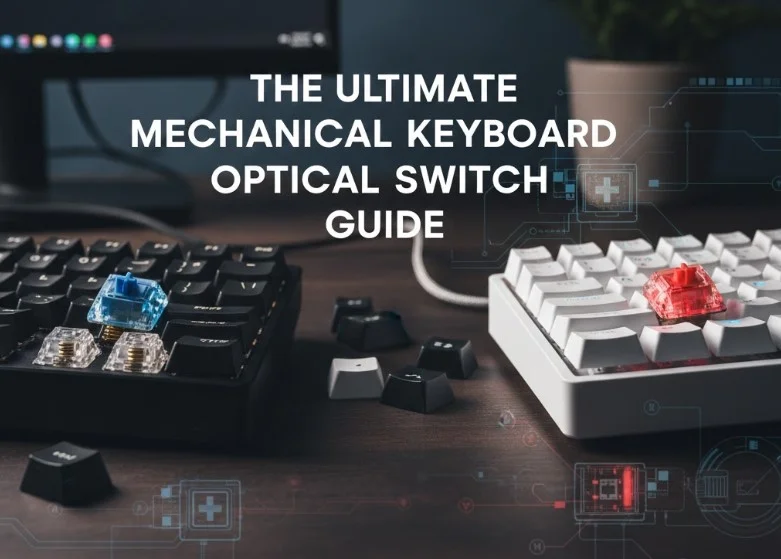
The Ultimate Mechanical Keyboard vs Optical Switch Guide
The world of computer peripherals is constantly evolving, but few battles rage as fiercely as the one between the venerable mechanical keyboard vs optical switch guide.
Choosing the right keyboard is more than just picking a color; it’s about selecting the fundamental technology that translates your intention into digital action. Your choice impacts everything from gaming speed and typing comfort to keyboard longevity and customization possibilities.
This comprehensive mechanical keyboard vs optical switch guide will illuminate the differences, helping you decide whether to embrace the future of light-speed actuation or remain loyal to the satisfying tactile feel of the classic.
The core distinction that defines the mechanical keyboard vs optical switch guide comparison lies in their actuation mechanism; how the keystroke is registered by the keyboard’s circuitry.
For decades, mechanical keyboards have relied on a proven physical process, where each key press involves the movement of a plastic stem and a spring, culminating in two metal contacts physically touching to complete an electrical circuit.
This physical contact is the heart of the “mechanical” experience, providing the distinct feedback and sound that enthusiasts adore. However, this reliance on metal-on-metal contact introduces complexities like “debounce delay” and eventual wear and tear.
How They Work: The Actuation Mechanism Explained
Understanding the fundamental way a keystroke is registered is crucial in the mechanical keyboard vs optical switch guide debate. The core difference lies in the method used to signal the computer that a key has been pressed; a process called actuation.
While both types of switches involve the physical movement of a plastic stem, their execution of the final, critical step is entirely different, leading to the performance and feel distinctions we discussed.
The Mechanical Marvel: Relying on Physical Contact
The design of the traditional mechanical switch is a testament to reliable, time-tested engineering that has been refined over decades. It functions as a precise miniature electrical circuit controlled by physical force. When you press a key, the entire operation hinges on two pieces of metal making contact.
The actuation mechanism of a mechanical switch involves a carefully calibrated interaction between three main components: the stem, the spring, and the metal leaf contacts. As a downward force is applied to the keycap, the stem begins its travel down the switch housing.
The spring provides the necessary resistance and the force required to return the stem to its rest position. The stem is designed with an internal protrusion that, upon reaching a specific point in its descent pushes the two metal contacts together.
The moment these contacts physically touch, the circuit is closed, and an electrical signal is sent to the keyboard’s controller, signaling the keystroke.
This physical engagement is what provides the signature tactile feedback and auditory click, depending on the switch design.
However, this same physical contact mandates the use of debounce delay; a small, necessary pause in the processing of the signal to prevent electrical “bouncing” (chatter) from registering multiple unintended keystrokes.
This delay, though minimal, is the primary source of the speed difference noted in the mechanical keyboard vs optical switch guide.
The Optical Option: Leveraging Light-Speed Detection
Optical switches, often dubbed opto-mechanical, represent a significant evolution in keyboard technology by eliminating the need for physical electrical contact altogether.
They borrow the physical housing and key feel components from their mechanical ancestors but replace the electrical mechanism with a light-based detection system. This change is foundational to their speed and durability advantage in the mechanical keyboard vs optical switch guide.
The actuation mechanism of an optical switch centers around a beam of infrared light and a dedicated sensor on the keyboard’s printed circuit board (PCB).
Within the switch housing, positioned precisely on the pathway of the light beam, is an actuator; a small plastic piece, often part of the stem itself. When the key is pressed, the stem travels down, moving the actuator through the light beam.
Depending on the switch design, the actuation is registered either when the actuator interrupts the beam (breaking the connection between the light emitter and the sensor) or when the actuator unblocks the beam (allowing the light to pass through to the sensor).
The moment the sensor detects this change in light flow is the moment the keystroke is registered. Because light detection is virtually instantaneous and involves no physical contact that could cause electrical bouncing, the requirement for a debounce delay is eliminated.
This fundamental shift allows optical switches to register a press microseconds faster than a conventional mechanical switch, solidifying their position as the low-latency contender in the mechanical keyboard vs optical switch guide.
The Debounce Delay: The Critical Difference
To truly grasp the performance distinction in the mechanical keyboard vs optical switch guide, one must understand the purpose and impact of the debounce delay. This seemingly minor component is the technical crux that separates the two technologies in terms of raw speed.
Debounce delay is a mandatory software or hardware mechanism built into traditional mechanical switches to ensure signal integrity. When the two metal contacts in a mechanical switch touch, they don’t form a perfectly clean, immediate connection.
Due to the inherent springiness and minimal imperfections of the metal, the contacts might briefly separate and re-connect several times before settling into a stable connection.
Without debounce logic, the keyboard’s controller would register these momentary breaks and re-connections as multiple, rapid keystrokes; a phenomenon known as chattering.
To prevent this, the controller is programmed to wait a very short period (typically between 2ms and 5ms) after the initial contact before accepting the signal as a valid keystroke. This delay, while essential for reliability, adds a measurable amount of latency to every single keypress.
In contrast, the optical switch bypasses this entirely because the light beam detection provides a clean, immediate, binary signal (light/no light).
The sensor registers a definitive state change without the microscopic instability of metal contacts, thus removing the need for a compensatory delay and providing a true zero-latency advantage in the actuation process, as highlighted in the mechanical keyboard vs optical switch guide.
Speed and Latency: The Competitive Edge
For competitive gamers and speed typists, every millisecond counts. This is where the mechanical keyboard vs optical switch guide takes a sharp turn toward performance.
Optical: Near-Zero Latency
Optical switches are objectively faster than their mechanical counterparts because they eliminate the debounce delay inherent in metal contacts. While the mechanical components still move at the same physical speed, the detection of the press is near-instantaneous.
- Actuation Speed: The switch is technically triggered at the speed of light detection. The signal transmission time is significantly reduced.
- Debounce: Eliminated. This is the single biggest contributor to their speed advantage over traditional mechanical switches.
- Real-World Impact: For professional eSports players or those who live on the knife-edge of reaction time, this tiny reduction in input lag can translate to a marginal, but potentially game-winning, competitive edge.
Mechanical: Highly Responsive, But with a Caveat
Modern high-end mechanical keyboards are incredibly fast, with response times that are more than adequate for 99.9% of users. The key performance bottleneck is the required debounce time.
- Response Time: Typically 1ms to 2ms, which is still extremely fast.
- Customization for Speed: Some newer mechanical switches and keyboard PCBs use advanced firmware techniques to reduce debounce time, but they cannot entirely eliminate the need for it without risking chattering.
If absolute, measurable, minimal latency is your single highest priority, the optical switch is the winner in this category of the mechanical keyboard vs optical switch guide. For everyone else, the speed difference is unlikely to be humanly perceptible outside of a laboratory setting.
Durability and Lifespan: Longevity Matters
A keyboard is an investment, and longevity is a crucial part of the mechanical keyboard vs optical switch guide. How do these two technologies hold up to years of intense, repetitive key presses?
Optical: The 100-Million-Keystroke Benchmark
Since optical switches avoid the wear and tear associated with metal-on-metal physical contact, they boast a superior lifespan.
- Mechanism Longevity: The elimination of contact wear means the primary point of failure in a traditional switch is removed.
- Reported Lifespan: Many manufacturers rate their optical switches for 100 million keystrokes or more.
- Environmental Resistance: The sealed nature of the light sensor often makes optical switches more resistant to dust and moisture ingress, which can foul metal contacts over time.
Mechanical: Tried, Tested, and Tough
Mechanical switches have been the standard for decades for a reason: they are built to last.
- Reported Lifespan: Standard, high-quality mechanical switches are typically rated for 50 to 80 million keystrokes.
- Point of Failure: Over extended periods, the metal contacts can oxidize, fatigue, or become worn, leading to the eventual need for greater debounce delay or failure.
Optical switches have a clear technical advantage in lifespan due to the absence of friction and mechanical contact wear, making them the theoretical winner for long-term endurance in this portion of the mechanical keyboard vs optical switch guide.
Key Feel, Sound, and Customization: The Enthusiast’s Realm
For a dedicated keyboard enthusiast, performance metrics like milliseconds of latency often take a backseat to the deeply personal and tactile experience of typing.
The key feel, the acoustic profile, and the breadth of customization options define the joy of the mechanical keyboard hobby. This is the category where the classic switch technology has a significant, long-standing advantage, creating a stark contrast in the mechanical keyboard vs optical switch guide.
The Unrivaled Ecosystem of Mechanical Switches
The mechanical switch market benefits from decades of established design and a universal standard: the “MX-style” cross-stem. This standardization has fostered an unparalleled ecosystem of third-party innovation, giving users ultimate control over their typing experience.
The customization landscape for mechanical keyboards is expansive and deeply complex, ranging from simple component swaps to intricate modifications. Users can entirely change the feel and sound by replacing the switches with virtually any other switch on the market, provided the keyboard features hot-swappable sockets.
The availability is immense: hundreds of brands produce mechanical switches with subtle variations in spring weight, lubrication from the factory, stem material, and housing tolerances.
Beyond the switch itself, enthusiasts engage in practices like lubing the switches (applying specialized grease to the moving parts to smooth the travel and deepen the sound), adding switch films (thin pieces of material placed between the top and bottom housing to eliminate wobble), and selecting specific PCB materials and case dampening to fine-tune the acoustics.
This level of granular control and the sheer volume of compatible aftermarket components ensure that mechanical keyboards remain the undisputed champion for users who view their keyboard not just as a tool, but as a customizable instrument. This flexibility is a key differentiator in the ongoing mechanical keyboard vs optical switch guide debate.
The Nuanced and Diverse Key Feel
The “feel” of a switch is the most subjective yet critical element for enthusiasts, encompassing the resistance, the smoothness of travel, and the nature of the actuation feedback. Mechanical switches offer three fundamentally distinct and highly refined experiences.
The three primary categories; Linear, Tactile, and Clicky, each deliver a unique physical sensation. Linear switches (like Reds) offer a smooth, uninterrupted press from top to bottom, ideal for fast, repetitive gaming movements where any bump could be distracting.
Tactile switches (like Browns) incorporate a subtle, yet noticeable bump in the key’s travel, precisely at the point of actuation. This physical confirmation is incredibly satisfying for typing, as it allows the user to know the key has registered without “bottoming out” the switch.
Clicky switches (like Blues) take the tactile design a step further by using a separate component (a click jacket or click bar) to produce a loud, audible click simultaneously with the tactile bump, providing both auditory and physical feedback.
This complex variation is achieved through the subtle shapes and materials of the metal leaf and plastic stem inside the housing. Manufacturers spend significant time engineering these precise interactions to deliver crisp, consistent, and satisfying feedback.
In the mechanical keyboard vs optical switch guide, it’s the maturity and diversity of these finely tuned mechanical feedback mechanisms that optical switches struggle most to replicate precisely.
The Acoustic Profile and Keyboard “Sound”
For many in the enthusiast community, the sound a keyboard makes is as important as its feel. The mechanical switch provides a rich, complex acoustic profile that is entirely dependent on its internal components and external environment.
The sound signature of a mechanical keyboard is a complex symphony created by several interacting components: the sound of the keycap hitting the switch housing (bottom-out sound), the spring vibrating upon release (ping), the stem moving within the housing (scratch), and the sound of the metal contacts closing (clack or click).
Enthusiasts meticulously modify their keyboards to eliminate unwanted sounds and enhance desirable ones. For example, replacing standard aluminum springs with stainless steel or coating them with oil can eliminate the undesirable spring ping.
Adding foam or padding between the PCB and the keyboard case can transform a sharp, high-pitched clack into a deep, pleasing thock. This pursuit of the perfect sound, is a cornerstone of the mechanical keyboard hobby.
Optical switches, while offering quiet operation due to the lack of metal contact clack, often fail to produce this desirable, deep sound profile. Because the physical components (stem and housing) must be designed around the light mechanism, they often lack the precise tolerances and material mass that contribute to the rich sound sought after by those deeply invested in the mechanical keyboard vs optical switch guide.
Optical Switches: Replication and Limitation
Optical switch manufacturers have made considerable progress in replicating the feel of classic switches, but their reliance on proprietary standards remains the largest roadblock to full enthusiast adoption.
While modern optical switches are readily available in linear, tactile, and clicky variations, the core method of feedback is an imitation rather than a true replication.
For tactile and clicky optical switches, the “bump” or “click” must be generated by a purely plastic-on-plastic interaction within the housing, as the metal leaf is reserved for the light-based actuation.
This often results in a feel that is smoother, but sometimes perceived as less sharp or distinct than the authentic, spring-loaded engagement of a metal leaf in a true mechanical switch. The most significant limitation, however, is the lack of standardization.
Each major keyboard brand developing optical switches uses a proprietary design for the light sensor and switch housing interface. This means that a switch designed for one brand’s optical board will almost certainly not fit or function in another brand’s board.
This proprietary lock-in completely stifles the customization market, users cannot hot-swap between different manufacturers’ optical switches, severely limiting the breadth of choice and experimentation that is central to the mechanical keyboard hobby.
Therefore, while optical switches win on speed, the mechanical switch ecosystem remains the hands-down winner for customization in this essential segment of the mechanical keyboard vs optical switch guide.
Advanced Features: Looking Beyond the Basics
The fierce competition between the two keyboard technologies has spurred rapid innovation, resulting in features that go far beyond simple on/off key registration.
These advanced capabilities, powered by either light or metal contacts (or in some modern cases, magnetic sensors that share operational principles with optical switches), are what truly separate high-end gaming and productivity peripherals from standard keyboards.
The focus here shifts from core function to enhanced control, making these features a critical aspect of the mechanical keyboard vs optical switch guide for the discerning user.
Analog Input and Pressure Sensitivity: The Optical Advantage
One of the most revolutionary features enabled by the nature of optical (or related non-contact) switches is Analog Input. Unlike a traditional digital switch, which sends a simple “0” or “1” signal (key is up or key is down), an analog switch is capable of measuring the key’s position across its entire travel distance.
This advanced capability is rooted in the optical switch’s ability to measure how much the light beam is being blocked or allowed to pass by the stem’s actuator.
By converting the varying intensity of the light signal into a precise voltage reading, the keyboard knows if the key is pressed 0.5mm, 2.0mm, or 3.8mm down. This is the same principle used by joystick and controller triggers, allowing the keyboard to function with pressure sensitivity.
For gaming, this translates to entirely new forms of control: for example, a light press on the ‘W’ key could make a character walk slowly, while pressing the key fully could make them sprint.
In racing games, a partial press on the gas key provides gentle acceleration, offering a level of fine motor control that is impossible with a standard binary mechanical switch.
This fundamental shift from binary input to variable, continuous input is a unique and significant advantage in the mechanical keyboard vs optical switch guide for specific use cases like simulation and nuanced character movement.
Fully Adjustable Actuation Point: Customizing Sensitivity
Building upon the ability to sense key position throughout the key’s travel, advanced optical and non-contact switches introduce the feature of a Fully Adjustable Actuation Point. This allows the user to define precisely how far a key must travel before the keystroke is registered, offering unparalleled customization of input sensitivity.
On a standard mechanical keyboard, the actuation point is fixed by the physical design of the metal contacts, it might be 2.0mm and cannot be changed. However, with an adjustable actuation point, users can customize this distance in software, often with precision down to 0.1mm.
For competitive first-person shooter (FPS) gamers, keys like WASD can be set to an ultra-sensitive “hair trigger” actuation point of, say, 0.4mm to register movement instantly. Conversely, “Ultimate Ability” or “Grenade” keys can be set to a deeper, more deliberate 3.0mm actuation point to prevent accidental misfires during intense moments.
This ability to fine-tune the sensitivity of every individual key based on its function, optimizes the keyboard for performance and significantly reduces input errors. This level of software-defined physical control is one of the most compelling advantages for gaming in the modern mechanical keyboard vs optical switch guide.
Rapid Trigger Functionality: Instant Reset
A recent and powerful advancement in non-contact switch technology (shared by high-end optical and magnetic switches) is the implementation of Rapid Trigger functionality.
This feature completely eliminates the conventional switch reset point, offering an immediate reset and re-actuation ability that is impossible with traditional mechanical technology.
In a standard mechanical switch, after the key is actuated, it must travel back above the actuation point (the “reset point,” often slightly higher than the actuation point) before it can be pressed again to register a new keystroke. Rapid Trigger technology bypasses this reset distance entirely.
The key is registered as “off” the moment the switch begins to travel upwards, and it can be immediately actuated again as soon as the stem begins its downward travel again. The keyboard constantly monitors the key’s position and acts on any change in direction.
For high-speed movement in games, such as rapidly counter-strafing or quickly alternating between movement keys, this allows for near-instantaneous reversal of movement direction.
By eliminating the physical constraint of the reset point, the Rapid Trigger function provides a measurable and tangible advantage in precision-demanding, high-speed competitive gaming scenarios, furthering the high-performance argument in the mechanical keyboard vs optical switch guide.
Hot-Swapping and End-User Repairability: The Mechanical Edge
While optical switches dominate the advanced feature set for speed and positional input, the mechanical standard retains a significant advantage in Hot-Swapping and End-User Repairability, a feature valued for longevity and hobbyist customization.
Hot-swapping refers to the ability to remove and replace a switch without any soldering required, facilitated by specialized sockets on the keyboard’s PCB.
For traditional mechanical switches, this is a widely adopted feature because the universal “MX-style” pin and stem configuration allows users to swap in virtually any third-party mechanical switch (linear, tactile, clicky, silent, etc.).
This feature ensures the long-term viability of the keyboard; if one switch fails after years of use, the user can replace the single component in seconds, rather than discarding the entire keyboard or performing a complex, time-consuming repair.
In contrast, while many optical keyboards are technically hot-swappable, they are often restricted to the manufacturer’s own line of optical switches due to the proprietary nature of the light sensor alignment.
The flexibility to experiment with hundreds of different aftermarket mechanical switches is the enduring strength of the mechanical keyboard ecosystem, offering a customizable and repairable platform that stands out in the mechanical keyboard vs optical switch guide for its longevity and community support.
Conclusion
Ultimately, the battle in the mechanical keyboard vs optical switch guide isn’t about which technology is superior overall, but which set of strengths aligns perfectly with your individual priorities. Whether you prefer the classic, satisfying thud of metal contacts or the lightning-fast, silent precision of light, the perfect keyboard is waiting for you.