Securing the Best Affordable Gaming Laptops with 144Hz
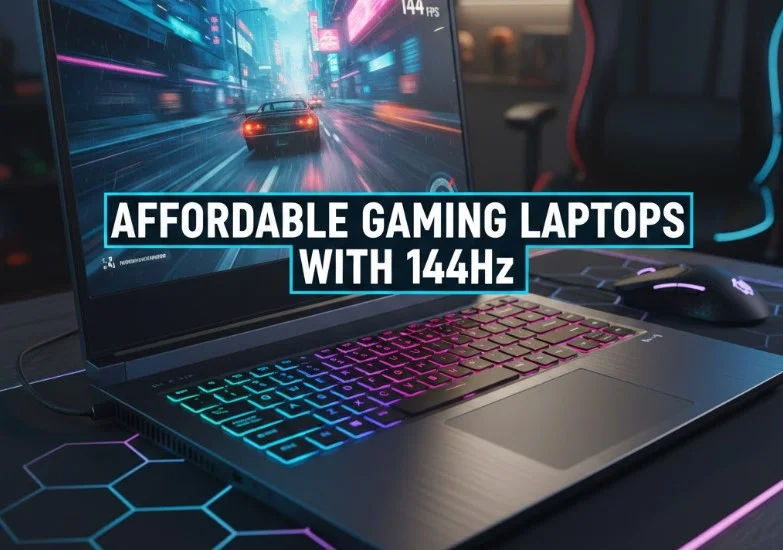
The quest for Affordable Gaming Laptops with 144Hz has become one of the most exciting trends in the tech world, driven by manufacturing efficiencies and relentless competition among top-tier brands.
No longer do you need a flagship machine to experience the silky-smooth motion that a 144Hz screen provides.
This sweet spot in the market represents the perfect compromise: a panel fast enough for serious competitive play in titles like Valorant, CS2, and Apex Legends, paired with modern, capable graphics cards and processors that can actually push frame rates high enough to take advantage of it.
This guide is dedicated to exploring the factors that make these budget-friendly beasts possible, highlighting the key components to look for, and showcasing the top contenders that prove high-refresh gaming is now within reach for every gamer.
In the fiercely competitive world of PC gaming, the difference between a glorious victory and a frustrating defeat can often come down to a single frame. For years, the gold standard for a truly smooth, responsive, and competitive edge has been the high refresh rate display, specifically the 144Hz panel.
This technology allows the screen to refresh its image 144 times per second, more than doubling the visual information you receive compared to a standard 60Hz monitor. For a long time, pairing this essential feature with powerful components meant a price tag that was anything but budget-friendly.
However, that era is over. Today, finding Affordable Gaming Laptops with 144Hz is not just a dream—it’s a vibrant, expanding reality, and we’re here to dive deep into how you can score a fantastic deal on a machine that delivers a superior visual experience without emptying your wallet.
Why Refresh Rate Matters with the 144Hz Advantage
The transition from a standard 60Hz display to a 144Hz panel is one of the most transformative upgrades a gamer can make, often having a more noticeable and immediate impact on performance and enjoyment than a simple GPU upgrade.
When seeking out Affordable Gaming Laptops with 144Hz, you are investing in a fundamental visual and interactive upgrade that redefines the fluidity and responsiveness of your entire system.
Eliminating Motion Blur and Enhancing Visual Clarity
The most immediate and striking benefit of a 144Hz display is the dramatic reduction, and near elimination, of motion blur, fundamentally enhancing visual clarity during rapid movement.
Standard 60Hz screens update the image only 60 times per second, meaning that when objects move quickly across the screen, like an enemy sprinting, a car zooming past, or a camera panning rapidly, the slow refresh rate smears the image data together. This results in a blurry, indistinct trail, making it difficult to track fine details.
A 144Hz display, by refreshing the image over twice as fast (144 times per second), presents many more distinct frames in the same amount of time. This “strobe effect” of rapid, clean images drastically cuts down on the perceived blur.
This isn’t just about aesthetics; in fast-paced competitive shooters, it means a target that is moving at high speed remains sharp and clearly defined, allowing for more precise tracking and aiming, a key advantage provided by Affordable Gaming Laptops with 144Hz.
Reducing Input Lag for Superior Responsiveness
Input lag, the delay between a physical action (like a mouse click or keyboard press) and the corresponding visual output on the screen, is significantly reduced when moving to a 144Hz refresh rate. Every time the screen refreshes, it’s capable of displaying the most current information sent from the system’s GPU.
At 60Hz, the maximum time a new frame has to wait to be displayed is approximately 16.67 milliseconds (1/60 seconds). At 144Hz, this maximum waiting time plummets to just 6.94 milliseconds (1/144 seconds).
This difference of nearly 10 milliseconds might sound small on paper, but in competitive gaming, it can be the difference between getting the first shot off and reacting too late. Because the monitor is ready to receive and display new frames almost twice as often, your commands are visualized on the screen much faster.
This decreased latency creates a feeling of direct control over the game, making actions feel instantaneous and natural, which is why a 144Hz panel is mandatory for truly competitive gameplay on Affordable Gaming Laptops with 144Hz.
The Competitive Edge: Faster Reaction Times
The ability to see fresh information sooner directly translates to faster human reaction times, granting a distinct competitive edge.
Studies have shown that a higher frame rate and refresh rate allow human players to react measurably quicker to on-screen events, particularly in scenarios where fleeting visual information is crucial, such as seeing an enemy peek around a corner or noticing a projectile heading your way.
When you play on a 60Hz screen, you are effectively operating with information that is up to 16.67 milliseconds old. By moving to 144Hz, you see that critical event nearly 10 milliseconds sooner.
Over hundreds of interactions in a match, this marginal difference accumulates, giving the 144Hz player a consistent advantage in winning ‘duels’ and making split-second tactical decisions.
For gamers serious about climbing ranked ladders, the investment in Affordable Gaming Laptops with 144Hz is the most cost-effective way to secure this fundamental performance boost.
Enabling the Full Potential of the Graphics Card
A high refresh rate display ensures that the powerful components within your laptop, specifically the dedicated GPU, are not throttled or bottlenecked by the screen itself.
Even if a laptop’s graphics card is capable of rendering 120 or 144 frames per second, a standard 60Hz display can only show 60 of those frames; all the GPU’s effort beyond that is essentially wasted from a visual standpoint.
The 144Hz display acts as a necessary pipeline to fully utilize the frame-generating capabilities of modern mid-range GPUs found in Affordable Gaming Laptops with 144Hz, such as the RTX 4050 or RTX 4060. By pairing the two, you guarantee that every single frame the GPU painstakingly renders is actually delivered to your eye.
This maximizes the return on your hardware investment, guaranteeing that you are getting the smoothest, most visually complete experience the laptop is capable of delivering in competitive and less demanding games.
The Features for an Affordable Gaming Laptop with 144Hz
Securing a genuine Affordable Gaming Laptop with 144Hz involves more than just checking a single box. It requires a harmonious configuration of components that are individually powerful enough to push frame rates into the high-refresh territory while remaining cost-effective.
Manufacturers strategically select mid-range parts that offer the best performance-per-dollar, creating a laptop that provides a superior 144Hz experience without the steep price tag of flagship models. Understanding these key features is essential to making an informed and budget-conscious purchase.
The Dedicated GPU: The Frame Rate Enabler
The Graphics Processing Unit (GPU) is the most critical feature in an Affordable Gaming Laptop with 144Hz, as it directly determines how many frames the system can generate per second.
To hit the 144 FPS target in 1080p resolution, the laptop requires a capable mid-range GPU, such as the NVIDIA GeForce RTX 4050 or RTX 4060, or their current AMD equivalents.
These graphics cards are highly optimized for Full HD gaming and crucially include features like DLSS (Deep Learning Super Sampling) and Frame Generation.
These AI-powered technologies can render games at a lower, less demanding resolution and then intelligently upscale the image, effectively giving the GPU a performance boost that makes the difference between hitting 80 FPS and easily soaring past 144 FPS, especially in competitive titles.
Without this level of GPU power, the magnificent 144Hz screen would be underutilized, displaying frame rates well below its potential.
CPU and Power Efficiency: Preventing the Bottleneck
While the GPU handles the rendering, a modern and efficient Central Processing Unit (CPU) is necessary to ensure the GPU is constantly fed data, preventing a performance bottleneck. Affordable Gaming Laptops with 144Hz typically leverage the latest generation of mid-range processors, such as the Intel Core i5 or AMD Ryzen 5 series.
These chips often feature a hybrid architecture with a balance of performance cores (P-cores) for high single-threaded tasks (like gaming) and efficiency cores (E-cores) for background processes.
The brilliance of choosing these specific CPUs is that they offer desktop-class gaming performance where it counts, but their lower thermal and power draw compared to top-tier i9 or Ryzen 9 models allows the laptop’s overall cooling system to be smaller and less complex, which is a significant factor in keeping the final product affordable.
Full HD (1080p) Resolution: The Cost-Performance Sweet Spot
A near-universal feature of all Affordable Gaming Laptops with 144Hz is the Full High Definition (FHD) resolution, specifically 1920×1080 pixels. This resolution choice is the absolute linchpin of the budget-to-performance equation.
Pushing a higher resolution, such as 2560×1440 (QHD), requires the GPU to render nearly double the number of pixels, immediately taxing the graphics card and making it nearly impossible for a mid-range GPU to achieve 144 FPS in demanding modern games.
By sticking to 1080p, manufacturers ensure that the GPU, paired with modern upscaling techniques, can realistically achieve and maintain high frame rates on the 144Hz display. This deliberate restraint on resolution is the primary reason high-refresh gaming has become so accessible and affordable.
16GB Dual-Channel DDR5 RAM: The System’s Backbone
For any modern gaming laptop, 16GB of RAM is rapidly becoming the essential minimum, and for Affordable Gaming Laptops with 144Hz, it must be configured in a dual-channel setup.
Dual-channel memory, achieved by using two smaller RAM sticks instead of one larger one (e.g., 2 x 8 GB instead of 1 x 16 GB), dramatically increases the bandwidth between the CPU and the memory, which can result in a tangible boost in frame rates, sometimes up to 20% in CPU-bound scenarios.
Furthermore, most modern budget machines are equipped with the faster DDR5 standard, providing quicker data transfer speeds than older DDR4, ensuring that the necessary game assets and information are available immediately, preventing the micro-stutters that can ruin a high-refresh gaming session.
High-Speed NVMe SSD Storage: Instant Immersion
Gone are the days when budget laptops compromised with slow, mechanical Hard Disk Drives (HDDs). Modern Affordable Gaming Laptops with 144Hz now universally feature at least a 512GB NVMe Solid State Drive (SSD).
NVMe drives utilize the high-speed PCIe bus interface, offering sequential read and write speeds that are exponentially faster than traditional SATA drives. This feature is crucial not only for quick boot times and fast application loading but, more importantly, for minimizing in-game load screens and texture pop-in.
A fast SSD allows massive game assets to be streamed quickly to the system, ensuring that when you transition to a new area or a critical moment loads, the game doesn’t pause or stutter, thereby maintaining the smooth, uninterrupted 144Hz experience.
Robust Thermal Design: Sustained Peak Performance
While not a glamorous spec like the GPU, an effective and robust thermal design is a mandatory feature for sustained performance in Affordable Gaming Laptops with 144Hz.
Budget laptops often use high-power components in relatively thin chassis, which can lead to thermal throttling, a system’s self-preservation measure that slows down the CPU and GPU when temperatures get too high.
Manufacturers achieve thermal stability in affordable models through clever engineering: utilizing multiple heat pipes that are dedicated to both the CPU and GPU, employing dual high-velocity fans, and designing large exhaust vents.
This ensures that the laptop can maintain its high clock speeds and TGP (Total Graphics Power) for extended periods during intense gaming sessions, guaranteeing that the system can actually sustain the high frame rates needed to leverage the 144Hz display without the frustrating dips in performance.
Top Picks for Affordable Gaming Laptops with 144Hz
The market for these value-focused machines is highly dynamic, with manufacturers like MSI, Acer, Dell, and Lenovo constantly battling to offer the best price-to-performance ratio. Here are the best deals on Affordable Gaming Laptops with 144Hz can be found:
1. Lenovo LOQ Series
Average Rating: 4.3 out of 5 stars
The Lenovo LOQ series is often positioned as the entry-level gateway to the quality and thermal design DNA of the highly-regarded Legion series. Pricing is typically very aggressive, with configurations featuring an NVIDIA RTX 4050 or RTX 4060 often found starting around the mid-to-high three figures.
Its rating of 4.3 stars is well-earned because it provides superior thermal performance compared to many direct competitors in the same price bracket, meaning the CPU and GPU can sustain higher clock speeds and TGP for longer periods without throttling.
The primary critique that prevents a perfect score is usually centered on its aesthetic, a relatively plain, plastic design and sometimes a slightly underwhelming brightness or response time on the 144Hz panel itself, which is a necessary compromise for maintaining the low price and exceptional gaming performance value.
2. HP Victus Series
Average Rating: 4.4 out of 5 stars
The HP Victus line stands out in the Affordable Gaming Laptops with 144Hz space by blending a minimalist, professional design with solid gaming hardware. Its pricing is particularly competitive, often seeing base RTX 4050/144Hz configurations priced to appeal to students and casual gamers who need an all-rounder laptop.
The high 4.4-star rating is driven by its strong “all-in-one” appeal: a chassis that is notably sleeker and less aggressively “gamer-themed” than rivals, a comfortable keyboard, and generally very good build quality for a budget machine.
The primary trade-off that keeps it in the affordable category is usually the GPU’s power limit (TGP), which can be slightly lower than chunkier competitors, and a display that, while fast at 144Hz, can have poor color accuracy (low sRGB coverage), which is fine for competitive gaming but less ideal for content creation.
3. Acer Nitro V / Nitro 5 Series
Average Rating: 4.2 out of 5 stars
The Acer Nitro V and its predecessor, the Nitro 5, have historically been the flagship models for Affordable Gaming Laptops with 144Hz, often the very first to introduce new-generation GPUs at the lowest possible price point.
Pricing is aggressively aimed at the sub-$1,000 threshold, maximizing raw component power over premium features. The 4.2-star rating reflects its reliable gaming performance and strong cooling system, which is typically quite effective at managing the thermals of the mid-range GPU options.
However, the rating also reflects common budget compromises: the chassis is almost entirely plastic, the design is often chunky and unapologetically “gamer-focused,” and the 144Hz screen, while fast, is typically one of the dimmer options on the market with below-average color vibrancy, which is a known trade-off for its exceptional price.
4. MSI Katana/Cyborg Series
Average Rating: 4.0 out of 5 stars
The MSI Katana and Cyborg series are MSI’s dedicated answer to the demand for Affordable Gaming Laptops with 144Hz, prioritizing the GPU-to-display core experience above all else. They are frequently found at the lowest available pricing for a given CPU/GPU combination, making them pure performance value plays.
The average rating of 4.0 stars is a fair assessment of a laptop that excels in its primary task, but makes noticeable compromises elsewhere.
The internal components often run hot due to a focus on thinness (especially the Cyborg line), the battery life is generally poor, and the build quality leans heavily on plastic. Gamers accept this rating because, for the money, the core performance delivered by the GPU and the smooth 144Hz experience is hard to beat, making it a powerful machine for its cost.
5. Dell G15 Series
Average Rating: 4.3 out of 5 stars
The Dell G15 maintains a strong position among Affordable Gaming Laptops with 144Hz by offering an unusually robust and tank-like build quality for its price segment. Pricing tends to sit slightly above the most entry-level competitors, but this is often justified by the laptop’s sheer durability and excellent thermals, which borrow heavily from Dell’s premium Alienware line.
The consistent 4.3-star rating is based on its outstanding cooling capacity, which allows the mid-range GPUs (RTX 4050/4060) to run at higher power limits, translating to better sustained frame rates than rivals.
The chief complaints that anchor the rating are its significant size and weight (it’s one of the heaviest budget options) and a thick-bezel, often duller 144Hz panel, indicating a choice to prioritize cooling power and chassis rigidity over portability and display aesthetics.
6. ASUS TUF Gaming Series
Average Rating: 4.5 out of 5 stars
The ASUS TUF Gaming series is a perennial favorite for Affordable Gaming Laptops with 144Hz due to its focus on military-grade durability and excellent cooling. TUF models typically offer pricing that is extremely competitive, especially for the RTX 4060 configurations, representing an incredible price-to-performance ratio for a durable machine.
Its high 4.5-star average rating comes from the combination of resilient, rugged build quality and a consistent thermal design that prevents throttling, which is rare at this price point.
The most frequent criticisms keeping it from a perfect score include a bulky design and the 144Hz display sometimes featuring a slower response time compared to pricier models, leading to slightly more ghosting, although this is marginal and only noticeable to the most sensitive competitive players.
7. Gigabyte G Series (e.g., G5/G6)
Average Rating: 4.1 out of 5 stars
The Gigabyte G series typically flies slightly under the radar but provides highly competitive configurations of Affordable Gaming Laptops with 144Hz, often packing a powerful CPU and GPU into a very simple, unassuming chassis.
Pricing is often aggressive, leveraging sales and online deals to offer high-spec components at a cost that undercuts many bigger brands. The 4.1-star rating reflects the laptop’s core strength: a powerful performance-per-cost ratio.
However, the rating acknowledges compromises in areas where costs are visibly cut: the overall build quality is often thin and flimsy, the trackpad is often basic, and the 144Hz screen, while fast, is known for particularly low brightness and poor colour gamut coverage. This is a machine for the user who cares only about frames per second and nothing else.
Smart Buying Strategies for 144Hz Gaming on a Budget
Securing an Affordable Gaming Laptop with 144Hz isn’t just about picking the right model; it’s about smart shopping and being strategic with your priorities.
1. Focus on the GPU/Display Combo
In the context of 144Hz gaming, the GPU and the display are the only components that truly matter for the high-refresh experience. If a laptop has a fantastic CPU but a weak GPU, it can’t hit 144 FPS. If it has a powerful GPU but a 60Hz screen, you can’t see the benefit.
Always prioritize a good GPU (RTX 4050/4060 class) paired with the 144Hz screen. Other components, like RAM and storage, are secondary, as they are often cheaper to upgrade yourself down the line.
2. Don’t Get Distracted by High-End Gimmicks
Avoid paying extra for features that don’t directly contribute to the core 144Hz gaming experience:
- 240Hz/300Hz Screens: Unless you are a professional esports player, the jump from 144Hz to 240Hz is marginal and requires a much more expensive, high-wattage GPU to be utilized properly. Stick to 144Hz for value.
- QHD/4K Resolution: A 1440p (QHD) or 4K screen will instantly tank your frame rate. You would need a much more expensive, high-end GPU to push modern games to 144 FPS at those resolutions. The 1080p 144Hz combination is the most cost-effective solution.
- Top-Tier CPUs: An i9 or Ryzen 9 is overkill. An i5 or Ryzen 5 from the latest generation is more than sufficient for high-refresh 1080p gaming.
3. The Power of Sales and Older Generations
Keep a sharp eye on seasonal sales events. This is when slightly older generation models, perhaps with an RTX 30-series GPU, are aggressively priced.
An RTX 3060 laptop, while a generation behind, can still offer an exceptional 1080p 144Hz experience and may be priced significantly lower than a comparable RTX 4050 machine. This strategy is key to finding truly Affordable Gaming Laptops with 144Hz.
Conclusion
The market has evolved to a point where a high refresh rate display is no longer an exclusive luxury. The search for the best Affordable Gaming Laptops with 144Hz has become a rewarding pursuit, yielding powerful, capable machines that provide a vastly superior gaming experience compared to the 60Hz laptops of the past.
By focusing your budget on the essential components, you can secure a machine that will deliver a competitive and enjoyable gaming experience for years to come. Don’t let a tight budget convince you that you have to settle for blurry, choppy gameplay. The revolution of high-refresh gaming is accessible, affordable, and waiting for you to jump in.