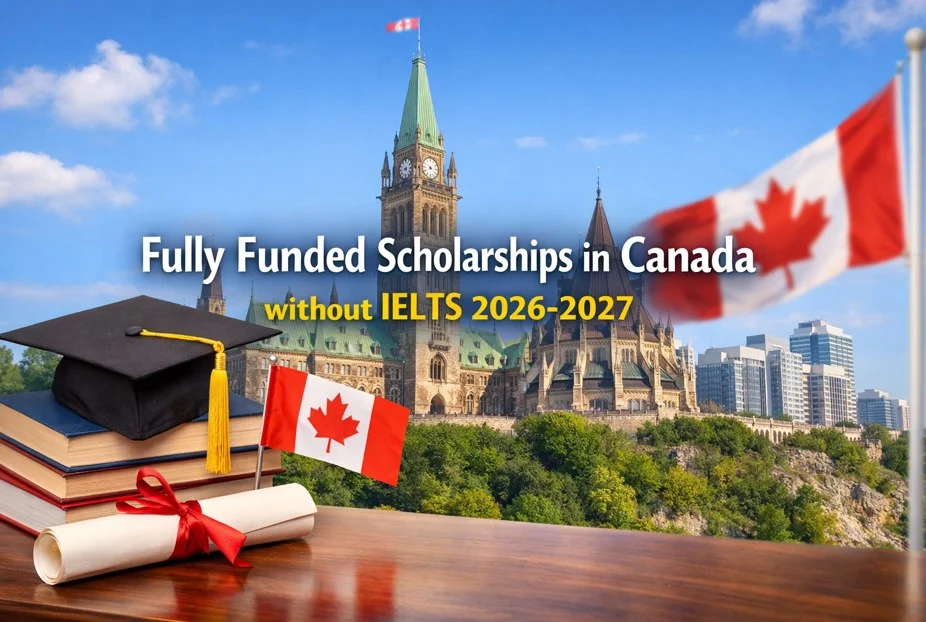
Fully Funded Scholarships in Canada without IELTS 2026/2027
Finding fully funded scholarships in Canada without IELTS 2026/2027 is the ultimate goal for many ambitious international students looking to study in North America.
Canada has solidified its position as a top-tier educational hub, but the hurdle of expensive English proficiency tests often stops brilliant minds from applying.
Fully funded scholarships in Canada without IELTS 2026/2027 are increasingly available as Canadian universities recognize alternative proofs of English proficiency.
Whether you are aiming for an undergraduate degree, a Master’s, or a PhD, the 2026/2027 academic cycle offers numerous pathways to secure high-value financial aid without the stress of an IELTS exam.
Why Study in Canada Without IELTS?
Choosing to pursue fully funded scholarships in Canada without IELTS 2026/2027 is more than just a matter of convenience; it is a strategic academic decision. Below, we explore the primary reasons why this route is becoming the preferred choice for the 2026/2027 intake.
Eliminating High Financial Barriers
The cost of taking the IELTS exam can be a significant burden, often exceeding $250 to $300 USD depending on your location.
For many students applying for fully funded scholarships in Canada without IELTS 2026/2027, this money is better spent on application fees or certifying official transcripts.
By opting for a waiver or a more affordable alternative like the Duolingo English Test (DET), you significantly lower the “barrier to entry” for your international education journey. This financial freedom allows you to apply to a wider range of institutions, increasing your chances of securing a full scholarship.
Focus on Academic and Research Excellence
Standardized tests like IELTS often require months of specialized coaching that focuses on “hacking” the test format rather than improving actual academic communication.
When you look for fully funded scholarships in Canada without IELTS 2026/2027, you shift your focus back to what truly matters to Canadian admissions committees: your GPA, your research proposal, and your community impact.
Universities that offer waivers often prioritize students who have a proven track record of studying in English-medium environments, acknowledging that four years of high school or university in English is a much better predictor of success than a three-hour exam.
Streamlined Admissions for 2026/2027
For the 2026/2027 academic year, Canada has introduced more streamlined processing for Master’s and PhD applicants, including exemptions from certain provincial attestation requirements.
By targeting fully funded scholarships in Canada without IELTS 2026/2027, you align yourself with this new era of efficient admissions.
Many institutions now offer “Conditional Admission,” where you can be accepted based on your grades and then simply complete a short, internal English bridge course. This prevents your application from being delayed by test center backlogs or slow score reporting.
Access to Diverse Alternative Assessments
The Canadian education system is leading the world in adopting modern assessment tools. Beyond the IELTS, students can now use PTE Academic, TOEFL iBT, or even the Canadian Academic English Language (CAEL) test, which is specifically designed to reflect the language used in Canadian classrooms.
Many fully funded scholarships in Canada without IELTS 2026/2027 are tied to these more accessible tests, which can often be taken online from the comfort of your home.
This level of flexibility ensures that students from remote areas or those with busy schedules are not left behind in the competition for global funding.
Leveraging the Medium of Instruction (MOI) Pathway
One of the most powerful reasons to study in Canada without IELTS is the ability to use a “Medium of Instruction” certificate.
If your previous degree was taught in English, most Canadian universities will accept a simple letter from your registrar as sufficient proof of proficiency. This pathway is particularly beneficial for students from Commonwealth countries or international schools.
It validates your past academic efforts and simplifies your checklist for fully funded scholarships in Canada without IELTS 2026/2027, making the dream of a Canadian degree much more attainable.
Fully Funded Scholarships in Canada without IELTS 2026/2027
Securing fully funded scholarships in Canada without IELTS 2026/2027 is a transformative goal for students worldwide who possess the academic talent but face barriers with standardized testing.
While many believe that English proficiency tests are an absolute requirement, many of Canada’s top-tier institutions offer waivers for students who have studied in English-medium environments or demonstrate excellence through other means.
Fully funded scholarships in Canada without IELTS 2026/2027 represent a commitment by the Canadian government and private donors to diversify the global talent pool.
For the 2026/2027 academic cycle, these awards range from undergraduate entrance grants to prestigious doctoral fellowships, ensuring that financial constraints and testing hurdles do not stand in the way of a world-class education.
Below are some of the most sought-after funding opportunities that offer comprehensive coverage for international students in the 2026/2027 intake.
1. Lester B. Pearson International Scholarship (University of Toronto)
This is arguably the most prestigious undergraduate award in Canada. It targets students who demonstrate exceptional academic achievement, creativity, and leadership.
For the 2026/2027 cycle, the scholarship covers tuition, books, incidental fees, and full residence support for four years.
While the University of Toronto generally requires proof of English proficiency, students from English-medium schools or those who have completed four or more years of full-time study in an English-language school system can often qualify for an IELTS waiver.
2. McCall MacBain Scholarships (McGill University)
The McCall MacBain Scholarship is a full-tuition award for Master’s and professional studies at McGill University. It is unique because it looks beyond grades, seeking students with a “character-first” approach and a history of community service.
Winners receive full tuition and fees plus a living stipend of $2,000 CAD per month. McGill accepts various forms of English proficiency evidence, and if your undergraduate degree was taught in English, you are typically exempt from submitting an IELTS score.
3. Vanier Canada Graduate Scholarships
Funded by the Government of Canada, the Vanier CGS is designed to attract world-class doctoral students. Valued at $50,000 CAD per year for three years, it is one of the highest-paying PhD scholarships in North America.
Because this is a federal award, the specific English language requirements are handled by the host university. Many participating institutions for the 2026/2027 session allow for IELTS waivers if the applicant’s previous research and degrees were conducted in English.
4. University of Alberta Graduate Entrance Scholarship
The University of Alberta has become a favorite for students seeking fully funded scholarships in Canada without IELTS 2026/2027. This scholarship provides a stipend of $17,500 for Master’s students and $21,000 for Doctoral students, plus an additional $10,000 to help cover international tuition fees.
The university has a long list of countries and specific universities from which they accept “English Medium of Instruction” certificates in lieu of IELTS.
5. Pierre Elliott Trudeau Foundation Scholarship
This PhD scholarship focuses on the humanities and social sciences, specifically themes like Human Rights, Responsible Citizenship, and Canada’s Role in the World. It provides $40,000 annually for three years to cover living expenses and $20,000 annually for research and travel.
Like other federal-level awards, the language proficiency requirement is mediated by the student’s chosen university, many of which offer flexible pathways for the 2026/2027 intake.
6. University of Waterloo International Master’s Award of Excellence
The University of Waterloo offers this award to high-achieving international students entering a research-based Master’s program. It is valued at $2,500 per term for up to five terms.
When combined with Research Assistantships (RA) and Teaching Assistantships (TA), the package often results in a fully funded experience. Waterloo is notably flexible with language requirements for students coming from recognized English-speaking educational backgrounds.
7. University of Calgary International Entrance Scholarship
This scholarship is worth $20,000 (renewable annually) and is awarded to international students entering their first year of an undergraduate degree. It recognizes outstanding accomplishments outside the classroom as well as academic success.
The University of Calgary allows students to satisfy the English Language Proficiency (ELP) requirement through several methods, including the completion of certain high school curricula (like IB or AP) or years of study in an English-speaking school.
8. Dalhousie University Harmonized Scholarship Process
Dalhousie University in Halifax offers a “harmonized” application that considers students for multiple awards at once, including the Killam Predoctoral Scholarship, which can be valued up to $42,000 per year.
For 2026/2027, Dalhousie continues to allow departments to recommend ELP waivers for exceptional candidates who have demonstrated their language skills through prior academic work in English-medium institutions.
9. President’s International Scholarship of Excellence (York University)
York University’s premier award for international high school applicants is valued at up to $180,000 ($45,000 per year for four years). This massive funding package is intended for “President’s International Scholars” who show immense leadership potential.
York provides an easy-to-navigate waiver system for students who have completed at least two years of full-time study in an English-language school system.
10. University of Manitoba Graduate Fellowships (UMGF)
The University of Manitoba Graduate Fellowships (UMGF) are merit-based awards open to students of any nationality who will be registered as full-time graduate students. For the 2026/2027 session, values are approximately $14,000 for Master’s and $18,000 for PhD students.
Many departments at the University of Manitoba will waive the IELTS requirement if the applicant provides a letter from their previous university confirming that English was the primary language of instruction.
11. University of Ottawa International English Admission Scholarship
This automatic scholarship is for top international students with an admission average of 80% or higher. It significantly reduces tuition fees, often by $7,500 to $10,000 per term.
Because the University of Ottawa is a bilingual institution, they are very accustomed to assessing language skills through diverse methods, often allowing students to skip the IELTS if they are enrolling in an English-stream program and have a relevant academic background.
12. Western University Welcome to Canada Admission Scholarship
Western University offers an unlimited number of these scholarships for the 2026/2027 academic year, valued at $10,000 each for the first year, alongside guaranteed residence.
For more comprehensive funding, students can apply for the International President’s Entrance Scholarships, valued at $50,000. Western allows for ELP waivers for students who have spent at least three years in an English-medium school system.
13. Banting Postdoctoral Fellowships
While strictly for those who have completed a PhD, the Banting Fellowship is the pinnacle of Canadian research funding, providing $70,000 per year for two years. This “fully funded” fellowship is highly prestigious and looks for research that will contribute to Canada’s economic and social growth.
English proficiency is demonstrated through the quality of the research proposal and the support of the host institution, making a separate IELTS score unnecessary for many top-tier applicants.
Strategic Ways to Secure These Scholarships
Securing fully funded scholarships in Canada without IELTS 2026/2027 requires a blend of academic excellence and strategic communication. Because you are bypassing a standard requirement, your application must be twice as convincing in other areas.
To ensure you stand out in the 2026/2027 cycle, you must master the art of the “waiver request” and build a profile that proves your English capabilities through action rather than a test score.
Below are the most effective strategies to secure your funding for the upcoming academic year.
1. Mastering the English Proficiency Waiver Request
To successfully secure fully funded scholarships in Canada without IELTS 2026/2027, you must learn how to officially request an English Language Proficiency (ELP) waiver. Most Canadian universities, such as the University of Toronto and Western University, have a formal “Exemption Request” process.
This usually involves submitting a specific form through the student portal after you have applied for admission. In your request, you must clearly state that you have completed at least 3–4 years of full-time study in a recognized English-medium institution.
By being proactive and filing this request early, you clear the technical hurdle that allows the scholarship committee to review your file without a red flag for “missing documents.”
2. Obtaining a Comprehensive Medium of Instruction (MOI) Certificate
One of the most powerful documents in your arsenal for fully funded scholarships in Canada without IELTS 2026/2027 is the Medium of Instruction certificate.
This is not just a simple letter; it should be an official document from your current or former university’s Registrar’s office, printed on letterhead, signed, and stamped.
It must explicitly state that all your courses, examinations, and research were conducted entirely in English. For the 2026/2027 intake, many schools also recommend that the certificate includes your grades in English-specific subjects to further validate your fluency.
Having this document ready before the application portal opens will give you a significant head start.
3. Early Engagement with Potential Research Supervisors
For graduate students, the key to fully funded scholarships in Canada without IELTS 2026/2027 often lies in the hands of a professor.
In Canada, many research-based Master’s and PhD programs are “supervisor-led,” meaning if a professor agrees to take you into their lab, they often provide the funding themselves or support your scholarship application.
When emailing a potential supervisor, write in impeccable English to demonstrate your proficiency. Mention that you have been educated in an English-medium environment and are seeking a waiver.
If a professor vouches for your language skills during the admission meeting, the graduate school is much more likely to approve your IELTS exemption.
4. Crafting a High-Impact Statement of Intent (SOI)
Your Statement of Intent is your voice in the application room. When applying for fully funded scholarships in Canada without IELTS 2026/2027, your SOI must be flawlessly written to serve as living proof of your writing ability.
Use sophisticated vocabulary and clear, logical transitions to demonstrate that you can handle the rigors of Canadian academic writing. Instead of just listing achievements, tell a story of how your research or studies will solve a specific problem in Canada or your home country.
A compelling, error-free SOI can often lead a committee to conclude that an IELTS score would be redundant in your case.
5. Leveraging Alternative Online Assessments like Duolingo
If a university is hesitant to grant a full waiver for fully funded scholarships in Canada without IELTS 2026/2027, propose an alternative assessment like the Duolingo English Test (DET).
For the 2026/2027 cycle, the DET is widely accepted across Canada (including at McGill and Queen’s University) because it is affordable (approx. $59 USD) and can be taken from home.
It serves as a middle ground, you avoid the $300 cost and the physical stress of an IELTS center, while the university gets a verified score. Mentioning your willingness to provide a DET score in your initial inquiry shows you are a flexible and serious candidate.
6. Utilizing the “English-Speaking Country” Exemption List
Many students are unaware that Canada maintains a specific list of countries exempted from English testing. If you are from a country like Nigeria, Ghana, Kenya, or Singapore, you should never have to pay for an IELTS exam to get fully funded scholarships in Canada without IELTS 2026/2027.
When filling out your application, ensure you check the “English is my primary language” box or the “Exempt Country” category. If the system still asks for a score, immediately email the admissions office with a scan of your passport to have the requirement manually removed from your checklist.
7. Securing Strong Academic Recommendations
Letters of recommendation are critical when you are looking for fully funded scholarships in Canada without IELTS 2026/2027. Ask your referees, preferably professors who have taught you in English, to include a specific sentence or paragraph about your English proficiency.
They can vouch for your ability to participate in class discussions, write complex reports, and present research in English. This third-party validation from an academic professional carries immense weight with Canadian scholarship boards and often replaces the need for a standardized score report.
Challenges and Considerations when Pursuing Fully Funded Scholarships in Canada without IELTS
While the prospect of obtaining fully funded scholarships in Canada without IELTS 2026/2027 is incredibly exciting, it is essential to approach the process with a realistic understanding of the hurdles involved.
Navigating the Canadian education system without a standardized test score requires extra diligence, as you will be operating outside the “standard” application track.
Applying for fully funded scholarships in Canada without IELTS 2026/2027 means your profile must be airtight in other areas to compensate for the lack of a universal language metric.
Understanding the following challenges and considerations will help you prepare a more resilient and successful application for the 2026/2027 academic cycle.
The Increased Burden of Proof on the Applicant
When you apply for fully funded scholarships in Canada without IELTS 2026/2027, the “burden of proof” shifts entirely to you. In a standard application, an IELTS score of 7.5 instantly tells a committee you are proficient.
Without it, you must provide a mountain of secondary evidence, Medium of Instruction (MOI) letters, high school transcripts showing English grades, and perhaps even samples of previous academic writing.
For the 2026/2027 intake, committees are expected to be more rigorous in their review of these “non-standard” documents. If your MOI letter is missing a stamp or doesn’t explicitly state that your exams were in English, your application could be flagged as incomplete, potentially costing you the scholarship.
Potential Visa Processing Delays and Scrutiny
Even if a university grants you admission and a scholarship, the Canadian immigration department (IRCC) operates independently. For the 2026/2027 cycle, IRCC has introduced stricter vetting for study permits following the closure of the Student Direct Stream (SDS).
While you can still get a study permit for fully funded scholarships in Canada without IELTS 2026/2027, your visa application may face longer processing times. Visa officers use language scores as a quick way to verify that a student is “genuine.”
Without an IELTS score, the officer must manually review your MOI and SOP to ensure you won’t struggle in Canada. This increased scrutiny means your Statement of Purpose (SOP) must be exceptionally detailed regarding your academic history and language background.
Limited Scholarship Pools at Certain Institutions
It is a hard truth that some of the most lucrative fully funded scholarships in Canada without IELTS 2026/2027 are tied to specific departments that maintain strict testing rules.
While the university as a whole might offer waivers, high-competition programs like Medicine, Law, or certain MBA streams may still insist on an IELTS or TOEFL score to “level the playing field” among global applicants.
If you are targeting a top-tier scholarship at a school like the University of British Columbia (UBC), you might find that the “no-IELTS” path limits you to a smaller selection of awards compared to students who provide a test score.
Always check the specific “Terms and Conditions” of the scholarship itself, not just the general admission page.
Future Implications for Work Permits and Residency
A major consideration for those seeking fully funded scholarships in Canada without IELTS 2026/2027 is what happens after graduation.
As of 2026, Canada is implementing new rules that require language test results for certain Post-Graduation Work Permits (PGWP) and permanent residency pathways (like Express Entry).
While you can successfully complete your degree without IELTS, you will almost certainly need to take a language test (like CELPIP or IELTS General Training) eventually if you plan to stay and work in Canada.
Skipping the test now saves money in the short term, but it is important to factor in that you will likely need to demonstrate your proficiency formally to the government later in your journey.
Institutional Variation and “Hidden” Requirements
The decentralized nature of Canadian education means that rules change from province to province and school to school. A strategy that works for fully funded scholarships in Canada without IELTS 2026/2027 in Ontario might not work in Quebec or British Columbia.
Some universities have “hidden” requirements where they grant admission without IELTS but then force international students to take a “Diagnostic English Test” upon arrival.
If you fail this internal test, you might be required to pay for and attend extra English classes, costs that your scholarship may not cover. Always ask the international admissions office if there are any mandatory on-arrival language assessments.
Conclusion
The dream of studying in North America is closer than ever. By focusing on fully funded scholarships in Canada without IELTS 2026/2027, you remove financial and bureaucratic barriers that often discourage students. Start your application today, gather your English Proficiency Certificate, and prepare to join the vibrant academic community in Canada.